How to End a Tutoring Arrangement Professionally
10 min read
Contents
- When Should a Tutor Consider Ending Lessons?
- How to Tell Parents You Are Ending Tutoring
- What to Say to Parents: Message Templates
- What About Payments and Remaining Lessons?
- Should You Recommend Another Tutor?
- How to Prevent Similar Problems in the Future
- Frequently Asked Questions
- Final Thoughts
- Before the Final Lesson
Not every tutoring relationship works out as expected. Sometimes lessons fail to produce the desired progress, parents repeatedly ignore agreed terms, payments become an issue, or communication becomes increasingly difficult. In these situations, a tutor may decide that it is time to stop working with a student.
Ending a tutoring arrangement does not have to lead to conflict. The key is to communicate the decision clearly, give reasonable notice, agree on a final lesson date, and settle any outstanding payments or unused lessons. Knowing how to end a tutoring arrangement professionally helps protect both your time and your reputation.
When Should a Tutor Consider Ending Lessons?
One difficult lesson or an occasional disagreement is not necessarily a reason to stop tutoring. However, some problems become recurring and make effective teaching increasingly difficult.
1. Parents repeatedly ignore agreed terms.
Frequent last-minute cancellations, constant requests to reschedule, late payments, or expectations of extra work without additional compensation can undermine the working relationship.
If polite reminders and attempts to resolve the issue make no difference, it may be time to reconsider the arrangement.
2. Parents interfere with the teaching process.
Some parents regularly question teaching methods, demand constant changes to the learning plan, dictate how every lesson should be conducted, or expect immediate results regardless of the student's effort.
Parents should absolutely be involved in their child's education. However, if communication turns into ongoing disagreement and the tutor's professional judgment is consistently disregarded, productive cooperation becomes difficult.
3. The student is unwilling to participate.
A tutor can adapt teaching methods, introduce new activities, and make lessons more engaging. However, a teacher cannot replace a student's willingness to learn.
If a student consistently refuses to participate, does not complete agreed assignments, and shows little interest in lessons, while parents expect the tutor alone to be responsible for progress, the arrangement may no longer be effective.
4. The student's needs are outside the tutor's expertise.
Sometimes a tutor realizes that a student needs a different teaching approach, specialist support, or a level of expertise the tutor cannot provide.
In this situation, it is more professional to acknowledge the limitations and recommend looking for a more suitable specialist than to continue providing a service that does not meet the student's needs.
5. Your own circumstances have changed.
A heavier workload, a change in schedule, relocation, or other personal or professional circumstances may make it impossible to continue teaching.
You do not need to disclose private details, but it is important to inform the family in good time.
How to Tell Parents You Are Ending Tutoring
Once you have made your decision, avoid delaying the conversation or gradually becoming less available in the hope that the family will stop contacting you.
It is better to communicate directly, politely, and without excessive justification.
A few principles can help:
- Speak from your own perspective. Instead of blaming the family, use phrases such as "I don't think I can provide the support your child needs" or "I have decided to bring our tutoring arrangement to an end."
- Avoid personal criticism. Even if parents have behaved unreasonably, there is no need to list every disagreement or turn the conversation into an argument.
- Set a clear final date. Parents should know when the last lesson will take place.
- Be clear about your decision. If you have already decided to stop tutoring, do not phrase your message as though you are asking for permission or approval.
There is a difference between discussing a problem and informing someone of a final decision. If you are willing to give the arrangement another chance, suggest discussing new expectations. If your decision is final, communicate it without leaving room for misunderstanding.
What to Say to Parents: Message Templates
The right wording depends on why you are ending the arrangement. You do not need to provide a detailed explanation. A short, honest message is usually enough.
If your schedule has changed:
"Hello! I wanted to let you know in advance that due to changes in my workload, I will no longer be able to continue lessons in our current format. I suggest scheduling our final lesson for [date]. Thank you for working with me, and I wish [student's name] all the best with their studies."
If you are not the right tutor for the student:
"Hello! After working together for some time, I have come to the conclusion that my teaching approach may not be the best fit for [student's name] and their current learning needs. I believe another tutor with a different approach may be more suitable. I suggest that we finish our lessons after [date]. Thank you for your trust and understanding."
If parents repeatedly disregard agreed terms:
"Hello! Unfortunately, we have recently found it difficult to stick to our original arrangements regarding scheduling and lesson organisation. It is important to me that both sides respect each other's time and agreed working conditions. As we have not been able to resolve this, I have decided to end our tutoring arrangement. I suggest that our final lesson take place on [date]."
If you prefer not to give a detailed reason:
"Hello! I wanted to let you know that I have decided to bring our tutoring arrangement to an end. I suggest that [date] be our final lesson. Thank you for the time we have spent working together, and I wish [student's name] every success with their learning."
What About Payments and Remaining Lessons?
Once you have informed the family, make sure all financial and practical matters are settled. This helps prevent misunderstandings, even if the working relationship has not been particularly smooth.
If lessons have been paid for in advance, check how many sessions remain. Agree whether they will take place before the final date or whether the cost of unused lessons will be refunded.
If there are outstanding payments, state the exact amount and agree on how and when it will be paid. Ending the arrangement does not mean that completed lessons should be left unpaid.
If your cancellation policy includes fees for missed lessons, follow the terms that were agreed upon before tutoring began. Do not introduce new charges or payment conditions after the fact.
If the student has learning materials or unfinished work, arrange to return or share them with the family. You may also provide a brief summary of the topics covered and suggest what the student could work on next.
It is good practice to confirm the final arrangements in writing, including the last lesson date, any remaining sessions, and the amount to be paid or refunded.
Should You Recommend Another Tutor?
You are not obliged to find a replacement, but a recommendation can be helpful in some situations.
If you believe the student needs a different teaching approach or a more specialised subject tutor, you can suggest what kind of professional the family should look for. If you know a reliable colleague, you may offer their contact details, provided they are happy to be recommended.
However, you do not need to take responsibility for finding another tutor if you do not have the time or simply prefer not to.
If you are ending the arrangement because of inappropriate behaviour, threats, or serious boundary violations, a brief and professional conclusion is enough. You do not have to maintain further contact out of a sense of obligation.
How to Prevent Similar Problems in the Future
Many difficulties can be avoided before regular lessons even begin. Tutors should establish clear expectations and working conditions from the outset.
It is useful to put the following points in writing:
- Lesson fees and duration.
- Payment methods and deadlines.
- Cancellation and rescheduling rules.
- Policies for missed lessons.
- The amount and frequency of feedback provided to parents.
- Conditions for ending the tutoring arrangement and settling outstanding payments.
You do not need a complicated legal contract. A clear, straightforward document that both sides can refer to is often enough to prevent misunderstandings.
You can use our ready-made Tutoring Agreement Template and adapt it to your own teaching practice before sharing it with parents or guardians.
It is also important to discuss expectations early on. Parents should understand what the tutor is responsible for, what role the student plays in their own learning, and what kind of progress can realistically be expected.
Keeping lesson records, payment information, and scheduling details in one place can also make things easier. For example, Tabula helps tutors track lessons, maintain lesson history, monitor payments, and keep track of cancellations and rescheduled sessions. This means that when a tutoring arrangement comes to an end, there is no need to reconstruct everything from scattered messages.

Tabula
Schedule, students and payments in one place
Frequently Asked Questions
Can I stop tutoring a student after just one lesson?
Yes. An initial lesson is an opportunity for both the family and the tutor to decide whether the arrangement is a good fit. If you realise that you cannot provide the support the student needs, it is better to communicate this early rather than create expectations you cannot meet.
Do I have to explain my decision if parents ask for a detailed reason?
You do not have to disclose private circumstances or justify your decision at length. A brief, polite explanation is usually sufficient. If the issue concerns the organisation of lessons or working conditions, you can mention it without turning the conversation into a list of complaints.
What if parents keep trying to persuade me to continue?
Stay calm and repeat your position without getting drawn into a lengthy discussion. For example: "I understand that you would like to continue lessons, but my decision is final. Thank you for understanding." You do not have to keep explaining yourself or offering compromises if you are not willing to consider them.
Can ending a tutoring arrangement damage my professional reputation?
Ending lessons does not automatically reflect badly on a tutor. What matters more is how the arrangement is brought to a close: giving reasonable notice, respecting agreed terms, settling payments fairly, and communicating professionally. You cannot always prevent a parent from leaving a negative review, but fear of criticism should not be the only reason you continue an arrangement that is no longer working.
Final Thoughts
Tutors have the right to end a working relationship when it is no longer productive, when agreed conditions are repeatedly ignored, or when the student's needs fall outside their professional expertise.
You do not have to accept unsuitable working conditions simply because you are afraid of upsetting parents or receiving a negative review. At the same time, you have a responsibility to the student: communicate the decision in good time, settle outstanding payments, and provide a clear ending to the arrangement.
Professionalism is not only about how you start working with a student. It is also about knowing how to end that relationship respectfully.
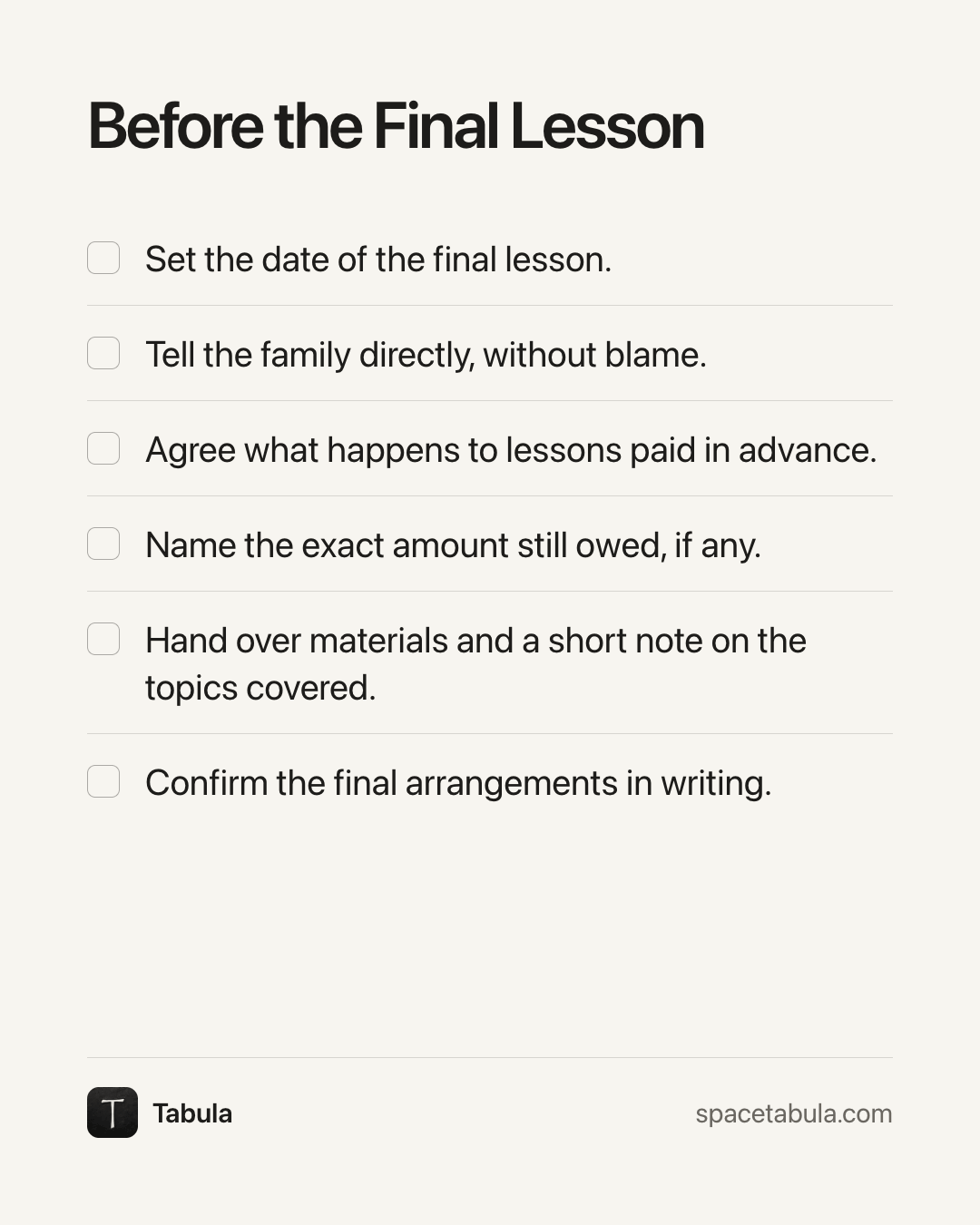
Before the Final Lesson
A short summary of this article: save it and tick off each step.
- Set the date of the final lesson.
- Tell the family directly, without blame.
- Agree what happens to lessons paid in advance.
- Name the exact amount still owed, if any.
- Hand over materials and a short note on the topics covered.
- Confirm the final arrangements in writing.
Tabula
spacetabula.com