What to Do When a Student Keeps Cancelling Lessons: A Tutor’s Guide
8 min read
Contents
- 1Set Clear Expectations Before Lessons Begin
- 2Create a Fair Tutoring Cancellation Policy
- 3What to Do When a Student Keeps Cancelling
- 4What to Say to a Parent Who Keeps Cancelling Lessons
- 5How to Reduce the Impact of Lesson Cancellations
- Frequently Asked Questions
- Final Thoughts
- Download the Tutoring Agreement Template
- Agree on Cancellations in Advance
If a student keeps cancelling lessons at the last minute, it can cost you both income and valuable teaching time. The best way to handle repeated cancellations is to set a clear tutoring cancellation policy, agree on it with the student or their parent in advance, and apply it consistently. If cancellations continue, discuss whether the current schedule still works or whether it is time to change the arrangement. Here’s how to protect your time, avoid unnecessary conflict, and manage your tutoring business more effectively.
1. Set Clear Expectations Before Lessons Begin
A written tutoring agreement helps prevent misunderstandings and gives both you and your students a clear understanding of how you work together.
You don’t necessarily need a complicated contract. A straightforward document outlining your main terms and conditions can be enough to get started.
Consider including:
- Lesson fees and payment terms: How much each lesson costs and when payment is due.
- Lesson format and location: Whether sessions take place online or in person.
- Schedule and duration: The agreed lesson times and how long each session lasts.
- Cancellation and rescheduling policy: How much notice is required and what happens if a lesson is cancelled late.
- Missed lesson fees: Whether late cancellations and no-shows are charged in full, partially charged, or handled differently.
- Homework and feedback: What students are expected to do between lessons and how you communicate progress.
- Lateness and tutor cancellations: What happens if either party arrives late or the tutor needs to cancel.
- Exceptions: How you handle illness, emergencies, or other unexpected circumstances.
Share your policy with the student or parent before the first lesson and give them an opportunity to ask questions. Depending on your location and working arrangement, you may also want to use a written agreement that both parties explicitly accept.
The goal is not to make tutoring feel overly formal. It is to make sure everyone understands the arrangement from the beginning.
2. Create a Fair Tutoring Cancellation Policy
A cancellation policy should be clear, reasonable, and easy to follow. Most importantly, it should reflect how you actually work.
For example, you could establish the following rules:
- Students must give at least 24 hours’ notice to cancel or reschedule a lesson without a fee.
- Lessons cancelled with sufficient notice can be rescheduled, subject to availability.
- Late cancellations and no-shows may be charged in full or partially, as agreed in advance.
- Illness and emergencies may be handled under a separate exception policy.
- If the tutor needs to cancel, the student can reschedule or receive a refund for any prepaid lesson that will not take place.
These are examples, not universal rules. Choose a policy that suits your schedule, teaching format, and local requirements.
Make sure your students or their parents agree to the policy before it takes effect. Explain any fees clearly, and check the consumer protection and contract rules that apply in your jurisdiction. Avoid introducing new charges retroactively.
A consistent policy also makes it easier to respond calmly when a cancellation happens. Instead of negotiating every time, you can refer to an agreement everyone already understands.
3. What to Do When a Student Keeps Cancelling
A single cancellation is rarely a reason to worry. Repeated last-minute cancellations, however, are worth addressing before they become a pattern.
Here is a practical approach.
Step 1: Address the first few cancellations calmly
Remind the student or parent of your cancellation policy. It is also worth asking whether the current lesson time is still convenient.
Sometimes the problem is not a lack of commitment. A child may have an overloaded schedule, a parent may be struggling with transportation, or an online lesson may regularly clash with another activity.
Understanding the reason can help you find a workable solution.
Step 2: Discuss the pattern directly
If cancellations continue, arrange a brief conversation with the parent or student.
Explain the practical problem without making it personal. You reserve time for each lesson, prepare materials, and may turn down other students who want the same time slot.
Then offer a specific solution, such as moving the lesson to another day or agreeing on a more realistic schedule.
Step 3: Change the arrangement if necessary
If the student continues to cancel despite your discussions, you have several options:
- Offer a different regular time slot.
- Allow bookings only for available sessions instead of reserving a permanent weekly slot.
- Apply your agreed cancellation policy consistently.
- End the arrangement professionally if it is no longer workable.
You do not have to keep a regular time slot unavailable indefinitely when a student repeatedly misses lessons.
Your time is part of your business, and protecting it is a reasonable part of being a professional tutor.
4. What to Say to a Parent Who Keeps Cancelling Lessons
Talking about cancellations can feel uncomfortable, especially when you have a good relationship with the family. A short, polite message is often more effective than a long explanation.
Here are two messages you can adapt to your situation.
A gentle reminder
“Hi! Just a quick reminder about our lesson cancellation policy. We’ve had a few last-minute cancellations recently, which makes it difficult for me to plan my teaching schedule. As agreed, I ask for at least 24 hours’ notice whenever possible. Please let me know if our current lesson time is still convenient for you. Thanks for understanding!”
When cancellations keep happening
“Hi! I wanted to check in because we’ve had several last-minute cancellations recently. I understand that plans can change, but I’m not able to keep reserving a regular time slot when lessons are frequently cancelled at short notice. We could look at a different schedule or switch to booking individual sessions, subject to availability. Let me know which option would work best for you.”
Both messages are firm without being confrontational. They focus on the practical issue, offer a way forward, and avoid blaming the student or parent.
5. How to Reduce the Impact of Lesson Cancellations
A clear cancellation policy is essential, but a few simple habits can make your schedule easier to manage.
- Send lesson reminders. A reminder the day before can help prevent forgotten sessions.
- Keep accurate lesson records. Track completed, cancelled, rescheduled, and paid lessons so that nothing gets overlooked.
- Offer cancelled slots to other students. If someone cancels early enough, let other students know that a time has become available.
- Review recurring problem slots. If the same student regularly cancels at the same time, consider changing the schedule.
- Review your policies periodically. As your tutoring business grows, your cancellation rules may need to change too.
You can manage your schedule and lesson history in a spreadsheet or use a tutoring management app such as Tabula to keep track of lessons and payments in one place.

Tabula
Schedule, students and payments in one place
The less time you spend sorting out cancellations and payment records, the more time you have for teaching.
Frequently Asked Questions
What should a tutor do when a student repeatedly cancels lessons?
Start by reminding the student or parent of your cancellation policy and asking whether the current schedule still works. If cancellations continue, discuss an alternative time, switch to booking individual sessions, or end the arrangement if necessary. Apply any cancellation fees only in accordance with your agreed terms and applicable rules.
Should tutors charge for cancelled lessons?
Tutors can establish a late cancellation or missed lesson fee, provided it is clearly communicated and agreed to in advance and complies with applicable local requirements. Some tutors charge the full lesson fee, while others use partial fees or make exceptions for emergencies. Choose a policy that works for your business and explain it before lessons begin.
How much notice should a student give to cancel a tutoring session?
A 24-hour notice period is one possible approach, although some tutors prefer 48 hours or use different rules for online and in-person lessons. The important thing is to choose a clear, practical deadline and communicate it before the student starts lessons.
How can tutors prevent last-minute cancellations?
Set expectations early, send reminders, agree on a regular schedule, and maintain a clear cancellation policy. If a student repeatedly cancels at the same time, discuss whether another time slot would be more realistic.
How should a tutor handle a parent who keeps cancelling lessons?
Stay professional and focus on the impact on your schedule rather than the parent’s intentions. Remind them of your agreement, explain what needs to change, and offer realistic alternatives. If the situation does not improve, it is reasonable to reconsider the arrangement.
Final Thoughts
A student cancelling a lesson occasionally is part of tutoring. Repeated last-minute cancellations are a different matter.
Set your expectations early, put your cancellation policy in writing, and address recurring problems before frustration builds. You can be flexible and understanding without making your own time endlessly available.
Clear boundaries are not about being difficult. They help you build a tutoring business that works for both you and your students.
Download the Tutoring Agreement Template
Set clear expectations from the start. This editable template helps you outline lesson schedules, fees, cancellations, rescheduling, communication, and other key aspects of working with students and their parents. Customize it to suit your tutoring practice and agree on the terms before lessons begin.
DOCX to fill in with Word, Pages or Google Docs, PDF to print.
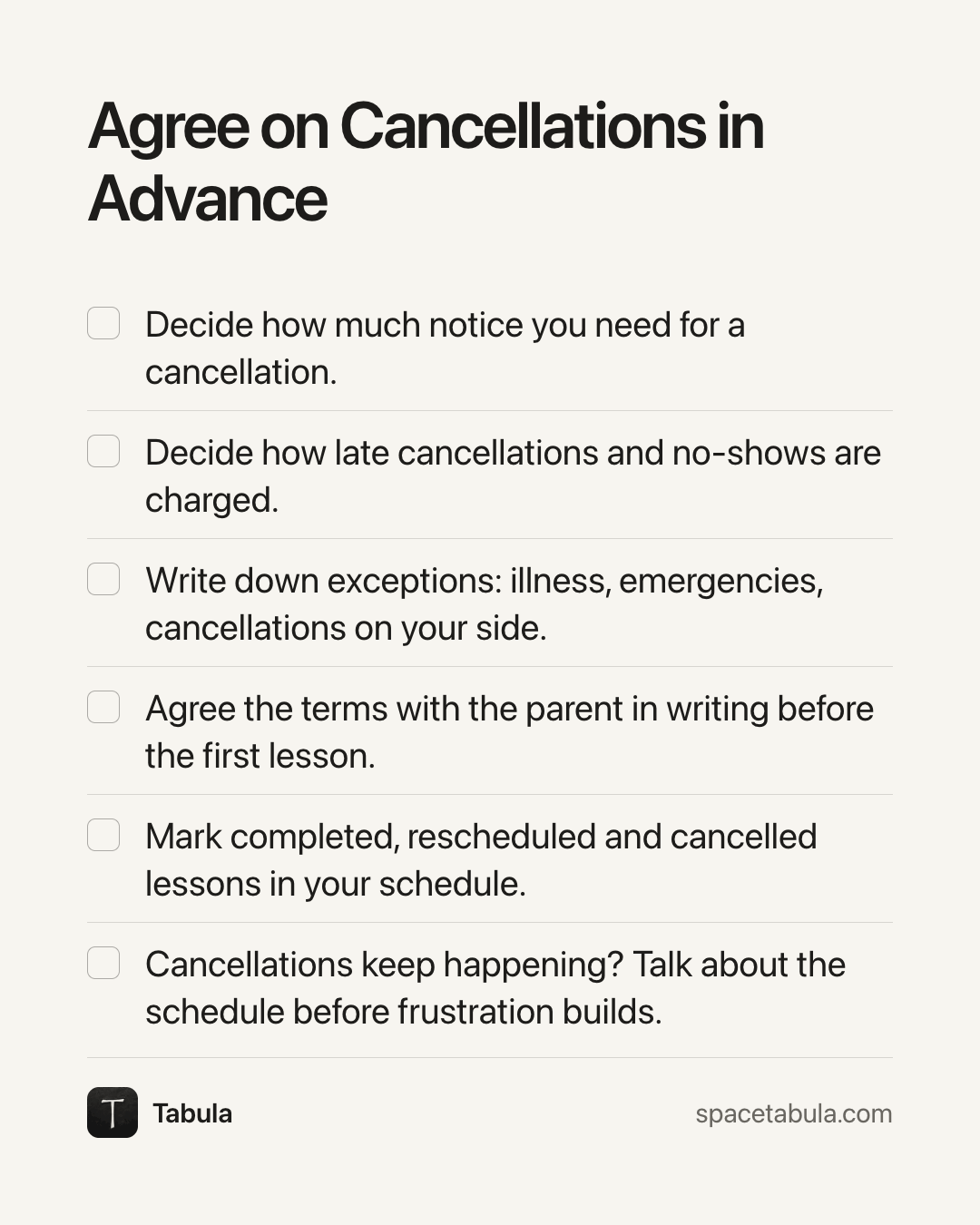
Agree on Cancellations in Advance
A short summary of this article: save it and tick off each step.
- Decide how much notice you need for a cancellation.
- Decide how late cancellations and no-shows are charged.
- Write down exceptions: illness, emergencies, cancellations on your side.
- Agree the terms with the parent in writing before the first lesson.
- Mark completed, rescheduled and cancelled lessons in your schedule.
- Cancellations keep happening? Talk about the schedule before frustration builds.
Tabula
spacetabula.com