What to Do When a Student Doesn’t Do Their Homework: A Tutor’s Guide
11 min read
Contents
- Why Students Don’t Do Their Homework
- What to Do When a Student Doesn’t Do Their Homework: A Step-by-Step Approach
- How to Talk to a Student Who Doesn’t Want to Do Their Homework
- How to Talk to Parents When a Student Isn’t Doing Their Homework
- How to Handle Lessons When a Student Hasn’t Done Their Homework
- What If a Student Consistently Fails to Do Their Homework?
- How Tabula Helps Tutors Stay Organised
- Frequently Asked Questions
- Final Thoughts
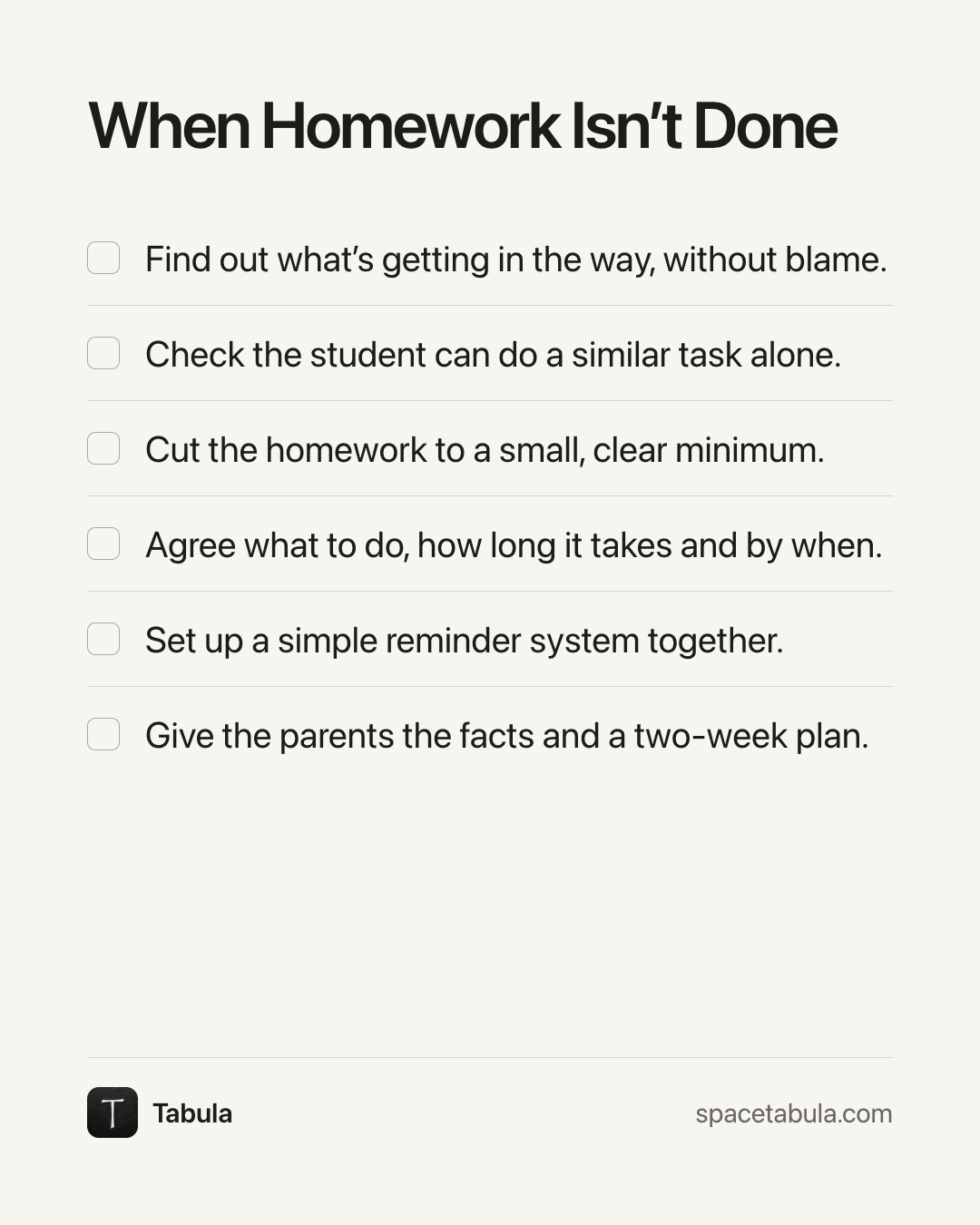
- When Homework Isn’t Done
Does your student regularly turn up to lessons without having done their homework? Do you find yourself going over the same exercises instead of moving on to new material? If a student isn’t doing their homework, the answer isn’t necessarily to give them more work, tell them off, or ask their parents to be stricter.
The first step is to understand why the homework isn’t getting done. The student may be struggling with the material, forgetting what they need to do, feeling overwhelmed, or simply not seeing the point of working independently. Each situation calls for a different approach.
Here’s how tutors can deal with unfinished homework, communicate with students and parents, and stop every lesson from turning into a catch-up session.
Why Students Don’t Do Their Homework
Although the problem may look the same from the outside, there can be several reasons behind it.
- The student doesn’t understand the material. During lessons, the student manages exercises with the tutor’s help but struggles to complete similar tasks independently. They may need more practice before they’re ready to work on their own.
- The workload is too heavy. School assignments, extracurricular activities, and other commitments leave little free time. Adding another long list of exercises can make homework feel overwhelming.
- The student keeps forgetting. They may agree to do the homework but forget to write it down, put it off, or simply lose track of it. Sometimes the issue isn’t a lack of motivation but underdeveloped planning skills.
- They don’t see the point. Some students attend tutoring because their parents expect them to. They may not understand why they need to do extra work, especially when the benefits seem too far away.
- They’re afraid of making mistakes. Difficult assignments can cause anxiety or frustration. Some children would rather avoid the task altogether than risk feeling unsuccessful again.
- They don’t feel responsible for completing it. The student knows that nothing much will happen if they turn up without their homework. The tutor will explain everything again, and the lesson will carry on as usual.
Don’t assume there is only one reason. Sometimes several factors contribute to the same problem.
What to Do When a Student Doesn’t Do Their Homework: A Step-by-Step Approach
Instead of making the same comments every week, try changing the way you approach the situation.
Step 1. Find Out What’s Getting in the Way
Start with a calm conversation. Asking, “Why haven’t you done your homework again?” is unlikely to get you an honest answer.
Try asking:
- Did you forget about the homework, or did you run out of time?
- Which exercise did you find difficult?
- Was there anything you didn’t understand?
- When would it be easiest for you to fit the homework in?
Your goal is to understand the problem, not simply get another promise that things will be different next time.
Step 2. Check the Difficulty and Amount of Work
Ask the student to complete a similar exercise independently. If they can’t manage without your help, they may need another explanation and more guided practice.
Also reconsider the amount of homework you’re setting. More isn’t always better. Three carefully chosen exercises can be more useful than a full page of tasks that the student is unlikely to complete.
Start with a small, manageable amount, such as:
- learning five new words;
- solving three maths problems;
- completing one grammar exercise;
- reading a short text and answering three questions.
The task should be clear, specific, and achievable.
Step 3. Agree on Clear Expectations
The student should know exactly what they need to do, how long it should take, and when it needs to be completed.
Discuss what they should do if they get stuck, too. Ask them to explain the assignment in their own words to make sure they understand the instructions.
Step 4. Help Them Build a Routine
If a student regularly forgets their homework, introduce a simple reminder system:
- writing assignments in a diary or notebook;
- keeping a separate homework list;
- setting reminders on their phone;
- using a simple checklist;
- choosing a regular time for independent study.
Show the student how to use the system, then gradually encourage them to take responsibility for planning their own work.
Step 5. Talk to the Parents
If the problem keeps happening, don’t wait until it becomes a source of conflict. Explain how often homework is left unfinished, how this affects lessons, and what you suggest changing.
How to Talk to a Student Who Doesn’t Want to Do Their Homework
Threats, guilt, and comparisons with other children rarely help students become more independent. Comments such as “You’ve let me down again” or “Other children manage just fine” are unlikely to improve the situation.
Instead, try agreeing on small, realistic steps.
If the student feels overwhelmed by the amount of work:
“Let’s choose the most important tasks. I don’t want you spending your entire evening on homework.”
If they keep forgetting:
“Let’s find a way to help you remember. Would you rather write your assignments in a notebook or set a reminder?”
If they’re afraid of difficult exercises:
“You don’t have to get everything right straight away. Just try the first exercise. If something doesn’t work, we’ll go through it together next time.”
If they refuse to work:
“I can’t do the assignments for you, but I can help you understand them. Let’s decide which part you can try on your own.”
The tutor’s role isn’t to demand obedience at any cost. It’s to help students gradually develop the skills they need to manage their own learning.
How to Talk to Parents When a Student Isn’t Doing Their Homework
Parents may react differently. Some want stricter supervision, others don’t consider homework particularly important, while some expect the tutor to solve the motivation problem entirely.
To keep the conversation constructive, follow three principles:
- Stick to the facts. For example, explain that homework was missed three times in the last four lessons.
- Avoid blaming anyone. The aim is to find a solution, not decide who is at fault.
- Suggest a practical plan. Explain what you intend to change and what support you need from the parents.
Here’s an example of a message you could send:
“I’d like to discuss something that’s affecting the progress of our lessons. Recently, homework has often been left unfinished. As a result, we have to spend time revisiting previously covered material, leaving less time for new topics.
I suggest trying a slightly different approach over the next two weeks. We could reduce the homework to a small, manageable amount and agree on a specific time for completing it. I’ll make the instructions clearer and pay closer attention to how independently your child can complete each task.
It’s important that we work together and gradually help your child develop a more consistent independent study routine.”
Parents can help by reminding children when it’s time to study, but they shouldn’t be doing the exercises for them or turning every evening into a homework inspection.
How to Handle Lessons When a Student Hasn’t Done Their Homework
Don’t let every lesson begin with a lengthy discussion about unfinished assignments. Tutors have a programme to follow, learning goals to meet, and limited time.
Try following this approach:
- Briefly find out what happened. A few minutes should be enough to understand why the homework wasn’t completed.
- Decide what actually needs attention. If the student hasn’t understood the topic, spend time explaining it. If they simply haven’t completed familiar exercises, you don’t necessarily need to work through every single one together.
- Keep the lesson moving. Don’t automatically abandon your lesson plan if the student has enough understanding to move on.
- Agree on what needs to change. Discuss how to avoid the same situation next time.
There’s an important difference between a student who struggles to understand the material and one who understands it but doesn’t organise their independent work. The first may need a different teaching approach; the second may need help developing planning skills and a sense of responsibility.
What If a Student Consistently Fails to Do Their Homework?
If you’ve already adjusted the workload, discussed the reasons with the student and spoken to their parents, but nothing changes, it’s time to reassess the arrangement.
Ask yourself:
- Does the student have clear learning goals?
- Do they understand why they’re having tutoring sessions?
- Is the workload appropriate for their age and abilities?
- Are the parents supporting the agreed approach?
- Is the student making progress during lessons?
If the student is engaged during lessons and gradually improving, it may be worth reconsidering how much independent homework they really need. Not every student benefits from the same approach.
However, if the student consistently refuses to participate, the parents aren’t willing to support the agreed arrangements, and no progress is being made, it may be time to discuss changing the lesson format or ending the arrangement.
A tutor cannot take full responsibility for a student's learning.
How Tabula Helps Tutors Stay Organised
When you work with several students, there’s more to keep track of than just lessons. You also need to remember previous arrangements, lesson history, cancellations, rescheduling, and payments.
With Tabula, tutors can manage their student lists, keep lesson histories, organise their schedules, track cancellations and rescheduled lessons, and record payments, outstanding balances, and advance payments.
This helps keep the administrative side of tutoring under control, so you spend less time trying to remember what was agreed during the previous lesson.
Of course, setting and reviewing homework remains part of the teaching process. The tutor decides what to assign, how to assess the work, and when a different approach is needed.

Tabula
Schedule, students and payments in one place
Frequently Asked Questions
Should tutors give every student homework?
No. Homework should reflect the student's age, goals, and abilities. If independent assignments aren't helping the student make progress or are creating too much pressure, it's worth reconsidering their format.
How can I get a child to do their homework?
You can't make a child develop a consistent and meaningful study routine through pressure alone. It's more effective to understand what's preventing them from doing the work, set manageable tasks, and agree on clear expectations.
What should I do if a student keeps forgetting their homework?
Help them create a reminder system. They can write assignments in a notebook, use a checklist, or set phone reminders. Gradually encourage them to take responsibility for planning their own work.
Should parents check whether their child has done their homework?
It depends on the child's age and level of independence. Younger children often need help organising their time, while older students should gradually become more independent. Parents can offer reminders and support without completing assignments for their children.
Should I still hold a lesson if the student hasn't done their homework?
Yes, unless there is another reason to cancel. You can address any difficulties, review essential material, and continue with the planned programme. Spending the entire lesson checking unfinished assignments isn't a productive long-term solution.
Should I stop tutoring a student who never does their homework?
Not immediately. First, try to understand the reasons and agree on changes with the student and their parents. If neither the student nor the parents are willing to cooperate and no progress is being made, consider changing the lesson format or ending the arrangement.
Final Thoughts
When a student doesn't do their homework, it's an opportunity to look at what's going wrong rather than simply make another complaint. They may need more help understanding the material, a more realistic workload, or a clearer system for organising their time.
A tutor's job is to create the conditions in which independent work becomes manageable, meaningful, and achievable. But responsibility for learning shouldn't rest entirely on the tutor. Progress is much more likely when the student, parents, and tutor understand their roles and are willing to work together.
When Homework Isn’t Done
A short summary of this article: save it and tick off each step.
- Find out what’s getting in the way, without blame.
- Check the student can do a similar task alone.
- Cut the homework to a small, clear minimum.
- Agree what to do, how long it takes and by when.
- Set up a simple reminder system together.
- Give the parents the facts and a two-week plan.
Tabula
spacetabula.com