How to Increase Your Income as a Tutor Without Working More Hours
10 min read
Contents
Many tutors face the same challenge: their schedules are almost full, their free time is shrinking, but their income isn't growing as much as they'd like. It may seem that the only way to earn more is to take on additional students and fill every available time slot. But that's not always the best solution.
You can increase your income as a tutor without working longer hours by reviewing your schedule, adjusting your rates, introducing small-group lessons, and reducing unpaid administrative work. The first step is to understand how you currently spend your time and identify which changes could make the biggest difference.
Here are several practical ways to earn more without turning your working week into an endless marathon.
1. Review Your Workload
Before looking for ways to earn more, take a closer look at how much you actually make and how much time you spend working.
For example, a tutor teaches 20 lessons per week at $30 per lesson. That's $600 in weekly income. At first glance, the numbers seem straightforward. But once you add lesson preparation, homework marking, messages with parents, rescheduling, and payment tracking, the working week becomes much longer than those 20 teaching hours.
That's why it's important to track not only the lessons you teach but also all the additional time required to support your students.
For one or two weeks, try keeping track of:
- the number of lessons you teach and the income they generate;
- time spent preparing lessons and marking homework;
- messages with students and parents;
- cancellations, rescheduling, and gaps in your timetable;
- unpaid lessons and outstanding payments.
This will help you identify which tasks take up the most time and which students or teaching formats generate the best return relative to the effort involved.
The main goal is to understand how much you really earn per working hour. You may discover that the problem isn't a lack of students but the amount of unpaid work that comes with teaching them.
2. Make Your Schedule More Efficient
Even if you have plenty of students, your timetable may not be organised as efficiently as it could be.
For example, you might teach three one-hour lessons spread throughout the day, with long breaks in between. You only teach for three hours, but your entire day is organised around work.
What can you change?
- Group lessons into blocks. Whenever possible, schedule lessons back-to-back, leaving reasonable breaks for rest.
- Reduce inconvenient gaps. If you regularly have long breaks between lessons, try arranging a more convenient recurring time with your students.
- Review less profitable time slots. For example, if you have to travel to another part of town for just one lesson, consider whether the time and travel costs are worthwhile.
- Set aside dedicated time for administrative tasks. Instead of answering messages and checking payments throughout the day, choose specific times to deal with them.
A well-organised schedule doesn't necessarily mean teaching more lessons. It helps you make better use of the time that would otherwise be lost between appointments and makes your working week more predictable.
3. Try Small-Group Lessons
Small-group teaching is one of the most straightforward ways to increase your income while keeping the same number of teaching hours.
For example, let's say an individual lesson costs $30. Instead of teaching one student, you could teach a group of four and charge each student $18. Your total income for that hour would be $72.
Each student pays less than they would for an individual lesson, while you earn more for the same amount of teaching time.
However, group lessons aren't suitable for every subject, age group, or learning goal.
This format works best when students have:
- a similar level of knowledge;
- comparable learning goals;
- a similar learning pace;
- the ability to work on shared tasks and activities.
For example, you could organise a small group for exam preparation, language learning, school curriculum revision, or writing skills.
Don't put students together simply to increase your income. If their knowledge levels differ too much, you'll have to constantly adapt the material to each individual. This can make lesson preparation more complicated and affect the quality of teaching.
Start with one small group and see how well the format works for both you and your students.
4. Review Your Rates
Increasing your rates is another way to earn more without adding extra teaching hours. If your schedule is almost full and you have very few available slots, it may be time to reconsider what you charge.
Start by asking yourself:
- Does your current rate reflect your experience and qualifications?
- How does it compare with tutors offering similar subjects and specialisations?
- How much time do you spend on preparation, marking, and communication outside lessons?
- How much demand is there for your services at your current rate?
You don't have to increase prices for all your students at once. You could introduce a new rate for new students while choosing a suitable date to update the fees for existing ones.
The important thing is not simply to charge more, but to understand the value you provide and make sure your rates reflect the quality of your work.
For more practical advice on setting new rates, informing parents about a price increase, and maintaining good relationships with students, see our article on how to raise your tutoring rates without losing students.
5. Reduce Unpaid Administrative Work
Preparing lessons and teaching students are far from the only tasks private tutors have to deal with.
You also need to manage your schedule, remember rescheduled lessons, record completed sessions, check payments, track outstanding balances and advance payments, and reply to messages. Each task may seem minor, but together they can take up several hours a week.
This is where many tutors lose time that could otherwise be spent resting, developing professionally, or working on their own projects.
Here are a few ways to make things easier:
- Use one central tool to manage your schedule instead of relying on several separate spreadsheets and message threads.
- Record completed, cancelled, and rescheduled lessons as soon as possible.
- Keep track of payments and outstanding balances so you don't have to reconstruct your financial records from old messages.
- Store student details and lesson history in one place.
- Establish clear cancellation and rescheduling policies to avoid repeatedly negotiating the same arrangements.
An app like Tabula can help with these tasks. Tutors can manage their schedules and student lists, keep lesson histories, record payments, track outstanding balances and advance payments, manage cancellations and rescheduling, and view financial statistics.
When your administrative tasks are organised in one place, it's easier to keep track of your workload and finances. You no longer need to search through message threads or manually combine information from several spreadsheets.

Tabula
Schedule, students and payments in one place
6. Rethink How You Work with Students
Sometimes increasing your income isn't about changing your rates or teaching more lessons. It's about organising your services more effectively.
For example, instead of making separate arrangements every week, you could agree on a regular schedule and offer lesson packages.
This approach can help you:
- plan your workload several weeks in advance;
- reduce the number of repeated scheduling conversations;
- make payments more predictable;
- understand how many lessons are planned and what income you can expect.
You can also review what is included in your lesson fee. If marking extensive homework, writing detailed progress reports, or providing ongoing support through messaging apps takes a considerable amount of time, it's worth setting reasonable boundaries around these tasks.
This doesn't mean giving up on feedback or individual attention. It simply means being clear about which services are included in your lesson rate and which require additional time.
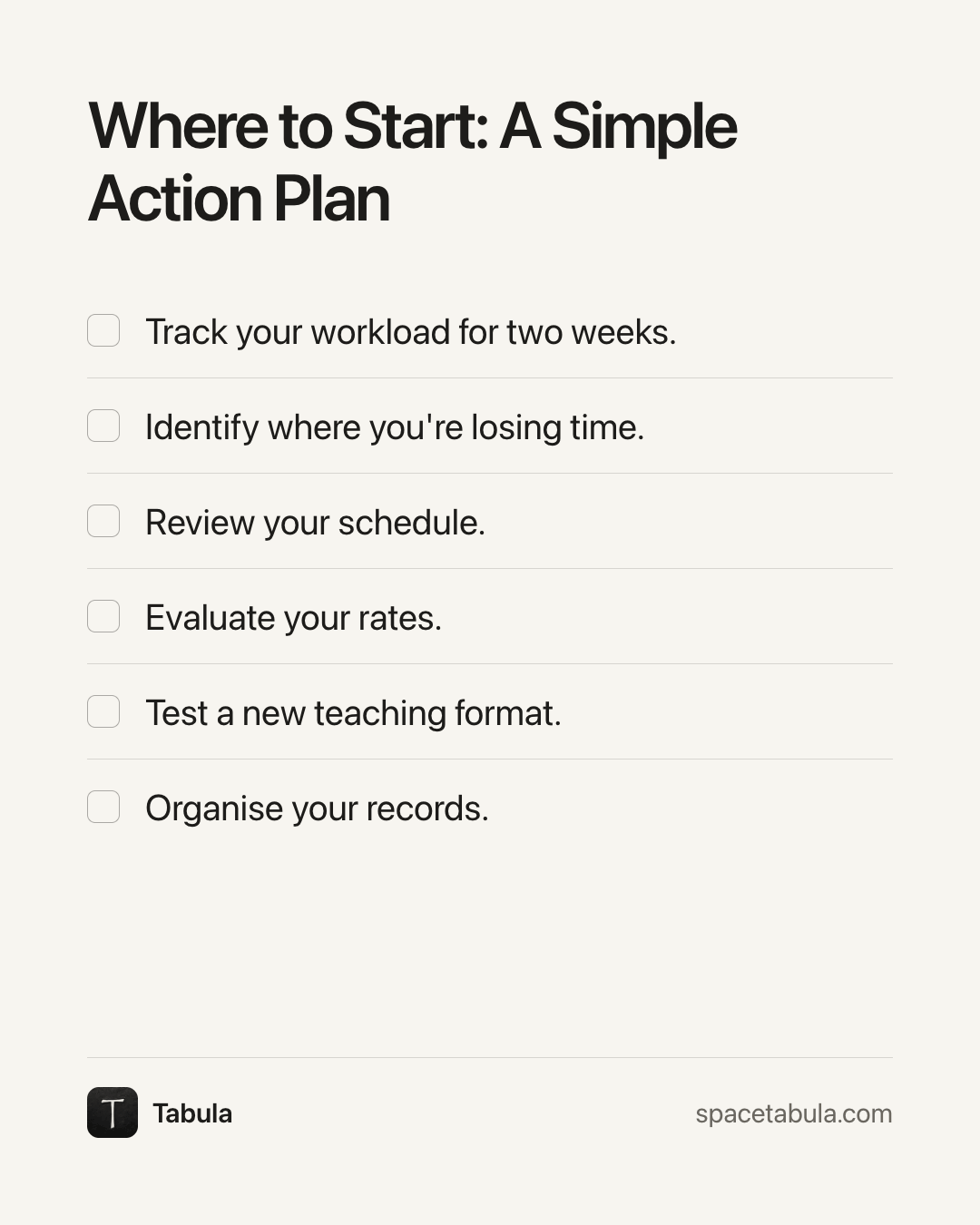
Where to Start: A Simple Action Plan
You don't have to change everything at once. It's much more effective to choose a few areas and gradually test what works.
- Track your workload for two weeks. Record your lessons, income, and time spent on additional tasks.
- Identify where you're losing time. Work out which tasks could be simplified, combined, or organised differently.
- Review your schedule. Try reducing inconvenient gaps and grouping lessons into blocks.
- Evaluate your rates. Check whether they reflect your experience, qualifications, and current demand.
- Test a new teaching format. For example, start one small group or offer a lesson package.
- Organise your records. Use a convenient tool to avoid repeatedly searching for information about lessons and payments.
Tabula
spacetabula.com
After a month, compare the results. Has your income changed? How much time do you spend working now? Has managing your schedule become easier?
Frequently Asked Questions
How can tutors increase their income if their schedules are already full?
If you have very few available hours, consider reviewing your rates, moving suitable students into small groups, and reducing the time you spend on administrative tasks. Improving the efficiency of your existing work can sometimes be more valuable than finding additional students.
Are group lessons profitable for tutors?
Yes, provided students have a similar level of knowledge and can follow a shared learning plan. For example, four students paying $18 each will generate $72 per teaching hour. Each student pays less than they would for an individual lesson, while the tutor earns more.
How can I tell if I'm spending too much time on unpaid work?
For one or two weeks, track not only your teaching hours but also the time spent preparing lessons, marking homework, replying to messages, rescheduling, and checking payments. If these additional tasks take up a significant part of your working day, it's worth finding ways to organise them more efficiently.
Can tutoring management apps help increase my income?
Apps don't automatically increase your rates or bring in new students. However, they can save time on administrative tasks, help you manage your schedule, and keep track of completed lessons and payments. This allows you to use your working hours more efficiently and maintain better control over your income.
Conclusion
Increasing your income as a tutor without working more hours is entirely possible. You don't necessarily need to keep looking for new students or fill every free slot in your calendar.
Sometimes, all it takes is reviewing your rates, bringing suitable students together in small groups, organising your schedule more effectively, and spending less time on administrative tasks.
Effective tutoring isn't about teaching as many lessons as possible in a day. It's about finding a sustainable balance between income, time, and teaching quality.
Professional development matters, but so does learning how to manage your own business. After all, a tutor's job isn't just to help students achieve their goals. It's also to build a sustainable teaching practice that leaves room for rest and a personal life.