How to Raise Your Tutoring Rates Without Losing Students
14 min read
Contents
- When Is It Time to Raise Your Tutoring Rates?
- How to Set Your New Tutoring Rate
- How to Raise Your Tutoring Rates: A Step-by-Step Plan
- How to Tell Parents About a Tutoring Rate Increase: Message Templates
- What If Parents Are Not Happy With the New Rate?
- 5 Mistakes to Avoid When Raising Your Tutoring Rates
- How to Keep Track of Your Rates and Payments
- Frequently Asked Questions
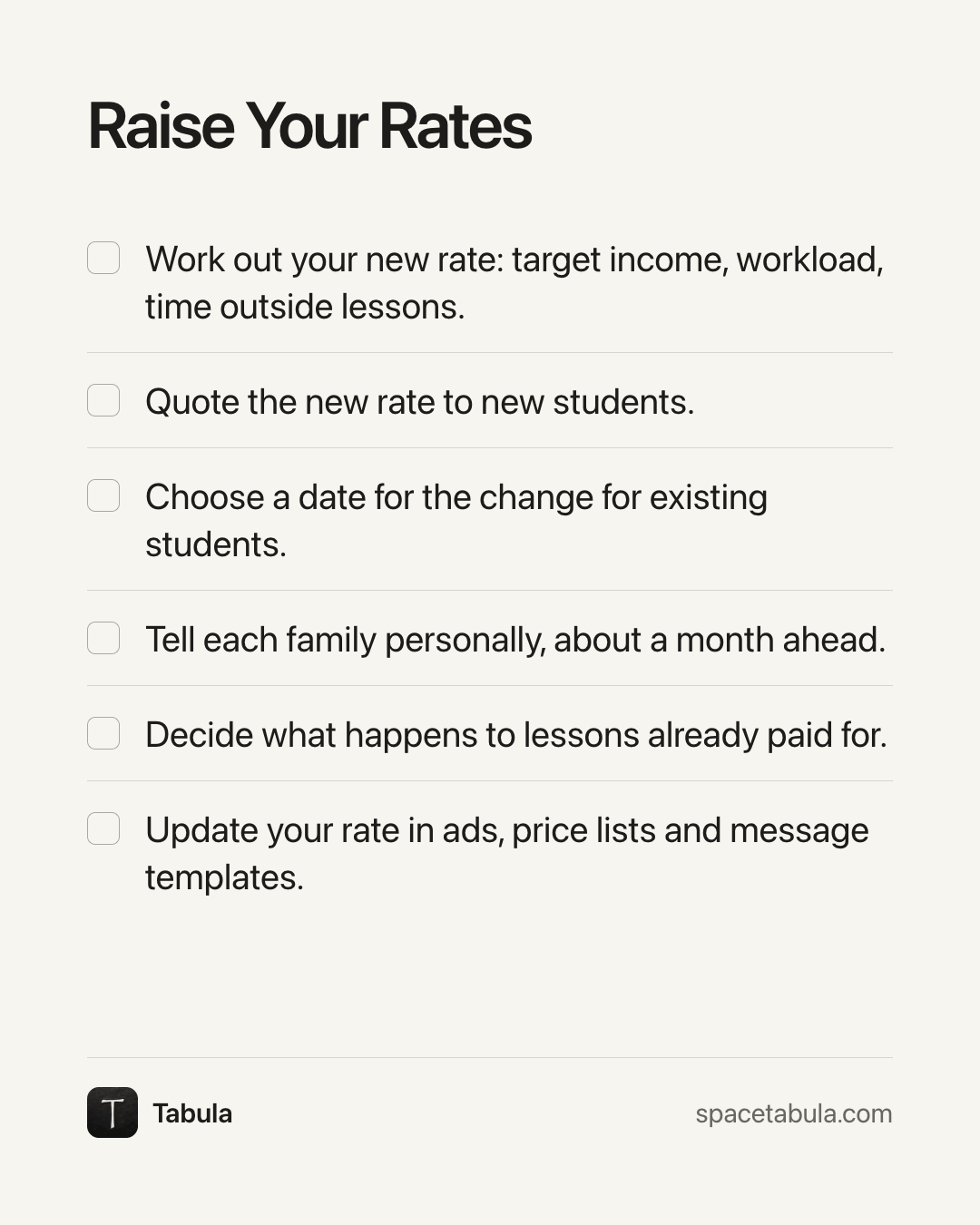
- Raise Your Rates
Raising your tutoring rates is a normal part of running a private teaching business. As you gain experience, develop new skills, and improve your teaching methods, the value of your work grows. Your preparation time, workload, and demand for your services may also increase. Yet many tutors put off raising their rates for one simple reason: they are afraid their students will leave.
The key to increasing your rates without damaging relationships with students and parents is to approach the change thoughtfully. Review your current pricing, decide on a new rate, choose the right time, and give families enough notice. A clear, respectful explanation is usually more effective than a long apology or an unexpected price change.
Here is how to prepare for a rate increase, what to say to parents, and what to do if they are not comfortable with the new price.
When Is It Time to Raise Your Tutoring Rates?
You do not have to wait until your schedule is completely full or you earn another qualification. There are several signs that it may be time to review your pricing.
- You have not increased your rates in a long time. Your experience, expenses, and working conditions may have changed significantly since you first set your prices.
- Your schedule is almost full. You receive regular enquiries but cannot take on every new student.
- Your qualifications have improved. You have completed additional training, developed new teaching methods, or started specialising in a particular subject or area.
- Your workload has increased. You create individual learning materials, mark homework, prepare lesson plans, or provide additional feedback to parents.
- New students are already paying more than existing ones. The difference between your old and current rates is becoming difficult to justify.
Remember, you do not necessarily need to introduce new services to justify a rate increase. Your experience, professional development, and time all have value.
How to Set Your New Tutoring Rate
Before informing students about a price increase, decide how much you actually want to charge.
Looking at what other tutors charge can be useful, but their rates should not be your only reference point. Every tutor has different circumstances: subject, student age, qualifications, lesson format, preparation time, and additional support.
Consider the following factors when reviewing your rates:
- Your target income. How much would you like to earn each month?
- Your realistic workload. How many lessons can you teach without becoming exhausted or compromising quality?
- Time outside lessons. Planning, marking assignments, communicating with parents, and administrative tasks are also part of your working hours.
- Demand for your services. How easily do you attract new students at your current rate?
- Your area of expertise. Exam preparation, specialised teaching, and work with specific learning needs may influence what you can reasonably charge.
Try not to compensate for low rates simply by teaching more lessons. There are only so many hours in a working day. Sometimes increasing your rate is a more sustainable solution than constantly taking on additional work.
How Much Should You Increase Your Rates?
There is no universal percentage that works for every tutor. A 10% increase may be reasonable for one person, while another may need a 20% adjustment to bring their income in line with their workload and expenses.
It helps to calculate a few different scenarios before making a decision.
For example, suppose you currently teach 12 lessons per week at $30 per lesson. Your weekly income is $360. If you increase your rate to $34 and teach 11 lessons, you will earn $374 per week.
This does not mean losing a student is necessarily a good thing. However, doing the maths helps you look at the situation objectively rather than making decisions based entirely on fear.
How to Raise Your Tutoring Rates: A Step-by-Step Plan
A rate increase should not come as a surprise to your existing students. Breaking the process into a few simple steps makes the transition easier for everyone.
1. Set Your New Rate for New Students First
This is one of the easiest ways to test whether your updated pricing is realistic.
When a prospective student contacts you, quote your current rate from the beginning. There is no need to explain what your existing students used to pay or justify why your prices have changed.
If new students continue booking lessons at the new rate, that is a useful indication that your pricing is competitive.
2. Choose a Date for the Change
For existing students, it helps to choose a clear and convenient starting point:
- The beginning of a new month.
- The start of a new school term or semester.
- The beginning of a new academic year.
- The end of a prepaid lesson package.
You do not have to wait until September to increase your rates. If you decide to make the change halfway through the academic year, simply choose another suitable date. The important thing is to avoid surprising families with an immediate price change.
3. Give Parents Enough Notice
A practical guideline is to give approximately one month's notice. This usually gives families enough time to review their budget and decide whether they want to continue.
If you offer prepaid lesson packages, explain how the new rate will affect existing bookings. A straightforward and fair approach is to honour the original price until all prepaid lessons have been used, unless different terms were agreed upon in advance.
4. Inform Each Family Personally
Do not rely solely on a social media announcement or an updated price list. Existing students and their parents should receive a direct notification.
Contact the parent or guardian you normally communicate with about scheduling and payments. Avoid putting a child in the position of having to pass on financial information between you and their family.
5. Update Your Pricing Information
Once you have informed your existing students, make sure your new rates are reflected everywhere: your website, social media profiles, tutor listings, price lists, and message templates for prospective clients.
This helps prevent misunderstandings and ensures that you do not accidentally quote an outdated price.
How to Tell Parents About a Tutoring Rate Increase: Message Templates
For many tutors, telling parents about a price increase is harder than making the decision itself. You may feel the need to explain every detail, describe how much preparation goes into each lesson, and convince parents that the new rate is justified.
But you do not need a lengthy explanation or an apology. A polite message with the new rate and its effective date is usually enough.
Here are a few examples you can adapt to your own communication style.
Template 1: A Simple and Professional Announcement
Suitable when you are simply updating your rates.
Hi [Parent's Name],
I wanted to let you know in advance that my lesson rate will change to [new rate] starting on [date].
Until then, our lessons will continue at the current rate.
Thank you for your understanding. I appreciate working with you and look forward to continuing our lessons!
Template 2: When Your Experience or Workload Has Increased
Suitable if you have genuinely developed your teaching approach or expanded the services you provide.
Hi [Parent's Name],
Over the past few months, I have reviewed my teaching approach, updated my lesson materials, and expanded the preparation and support I provide.
As a result, my lesson rate will increase to [new rate] from [date].
I wanted to give you plenty of notice so you have time to plan ahead. I would be very happy to continue working with [Student's Name]!
Thank you for your understanding.
Template 3: For Long-Term Students
If you have worked with a family for a long time and want to acknowledge your relationship:
Hi [Parent's Name],
We have been working together for quite some time, and I really appreciate your trust and the opportunity to support [Student's Name].
I wanted to let you know that from [date], my lesson rate will change to [new rate]. Our current rate will remain unchanged until then.
I hope we can continue working together, and thank you for being part of my teaching journey!
A small tip: Do not copy these messages word for word if they do not sound like you. A natural, genuine message is always better than something that feels overly formal or scripted.
What If Parents Are Not Happy With the New Rate?
Even if you handle the announcement professionally, some parents may respond with:
- "That's more than we can afford."
- "We weren't expecting the increase."
- "Could we keep the old rate?"
Try not to take these reactions personally. Every family has a different budget, and every tutor has their own financial and professional needs.
You have several options.
Offer a Different Lesson Format
If parents want to continue but cannot afford the new rate, you could discuss alternatives:
- Small-group lessons, if this format is suitable for the student.
- Less frequent sessions combined with independent practice between lessons.
- A different level of additional support, if it was previously included in your service.
However, do not offer exactly the same amount of work for less money simply because you are afraid of losing a student. If the price changes, it may make sense to adjust the format or scope of the service as well.
Consider a Short Transition Period
Sometimes a gradual increase can make the change easier. For example, you could introduce an intermediate rate for one month before moving to your full new rate.
If you choose this option, agree on a clear end date. Otherwise, a temporary arrangement can easily turn into a permanent discount.
Accept Their Decision Gracefully
If a family is not prepared to continue at your new rate, there is no need to argue or try to prove that your services are worth the money.
You could respond with something like this:
Thank you for letting me know. I completely understand that the new rate may not fit your budget.
I would be sorry to stop working together, but I respect your decision. If circumstances change in the future, I would be happy to hear from you again.
I wish [Student's Name] all the best with their learning!
Sometimes professionalism is not about keeping every client. It is about ending a working relationship respectfully when your expectations no longer align.
5 Mistakes to Avoid When Raising Your Tutoring Rates
- Announcing the increase at the last minute. Parents need time to plan their family budget. An unexpected change just before the next lesson can damage even a very good working relationship.
- Apologising for your decision. Phrases such as "I'm really sorry, but I have to increase my rates" can make it sound as though you are not confident in your own pricing.
- Making up reasons for the increase. There is no need to invent new services or refer to changes that have not actually happened. A brief and honest explanation is enough.
- Making exceptions out of guilt. If you increase rates for some students but keep offering the old price to others simply because you feel uncomfortable, managing your pricing becomes increasingly complicated.
- Measuring success only by how many students stay. After a rate increase, look beyond the number of lessons you teach. Consider your total income, workload, and free time. Sometimes a few newly available hours give you an opportunity to take on students at a higher rate or simply create a healthier work schedule.
How to Keep Track of Your Rates and Payments
As your tutoring business grows, so does the amount of information you need to manage. You may have different rates for different students, prepaid lessons, payment arrangements, and individual dates when new prices take effect.
Keeping all of this information in your head can quickly become confusing.
It helps to use a dedicated system to manage your students, lesson history, and payments. For example, Tabula allows tutors to keep student records, track completed lessons and payments, monitor outstanding balances and advance payments, and review financial statistics.
Having this information organised makes it easier to understand your actual income and manage pricing changes without losing track of individual arrangements.

Tabula
Schedule, students and payments in one place
Frequently Asked Questions
How often should tutors increase their rates?
There is no fixed schedule. You can review your pricing whenever your experience, demand, expenses, or working conditions change. It is better to reassess your rates regularly than to leave them unchanged for several years.
How much notice should I give parents before increasing my rates?
Around one month is a practical guideline for most tutoring arrangements. If you are planning to introduce new rates at the beginning of an academic year or term, you can let families know even earlier. The main goal is to give them enough time to make an informed decision.
Should I increase my rates for all students at the same time?
Not necessarily. You can introduce new rates for incoming students first and choose a separate transition date for existing families. However, it is worth having clear pricing rules so that temporary exceptions do not become permanent arrangements by accident.
What should I do if parents ask to keep the old rate?
Explain politely when the old rate will end and offer an alternative lesson format if one is suitable for both sides. You are not obliged to provide an ongoing discount if it does not work for your business.
Is it okay to raise tutoring rates during the school year?
Yes. You can increase your rates at any point if there is a good reason. Choose a suitable effective date and give parents advance notice. If the change is not urgent, the beginning of a new term or academic year may be more convenient.
Do I need to explain why I am increasing my rates?
A short and honest explanation is enough. You can mention professional development, changes to your teaching format, additional preparation, or a general review of your pricing. There is no need to provide a detailed justification.
Raising your rates is not a test of how much your students like you. It is part of developing a sustainable teaching business and valuing your own time and expertise.
When you understand the value of your work, feel confident in the quality of your teaching, and respect the financial circumstances of your students' families, conversations about pricing become much easier.
Not every student will necessarily stay, but that does not mean increasing your rates was the wrong decision.
Raise Your Rates
A short summary of this article: save it and tick off each step.
- Work out your new rate: target income, workload, time outside lessons.
- Quote the new rate to new students.
- Choose a date for the change for existing students.
- Tell each family personally, about a month ahead.
- Decide what happens to lessons already paid for.
- Update your rate in ads, price lists and message templates.
Tabula
spacetabula.com