How to Plan Your First Tutoring Session: A Step-by-Step Guide
10 min read
Contents
- 1What to Find Out Before the First Session
- 2How to Structure Your First Tutoring Session
- 3How to Assess a Student’s Current Level
- 4Should You Teach Something New in the First Session?
- 5How to Discuss the Results With the Student and Parent
- 6How to Agree on a Plan Going Forward
- First-Session Checklist for Tutors
- FAQs About the First Tutoring Session
- How to Keep Track of What You Learned in the First Session
Your first tutoring session is an opportunity to understand what a student needs, assess their current level, and decide how to move forward. You don’t need to test everything or solve every learning problem in one lesson. Focus on understanding the student’s goals, seeing how they approach a few well-chosen tasks, working through one specific challenge, and agreeing on the next steps.
Here’s a practical plan you can adapt to your subject, the student’s age, and your teaching format.
1. What to Find Out Before the First Session
You don’t need to spend the first 20 minutes of your lesson asking questions you could have answered beforehand. A short conversation with the student or their parent can help you prepare and choose suitable activities.
Find out:
- The student’s goals. Do they need help keeping up with schoolwork, preparing for an exam, filling learning gaps, or learning a subject from scratch?
- Their current challenges. Which topics do they struggle with? Are there specific assignments they find difficult?
- Their timeline. Is there an upcoming test, exam, or deadline?
- Previous tutoring experience. Have they worked with a tutor before? What worked well, and what didn’t?
- Learning materials. Which textbook or curriculum do they follow? Could you look at a recent test, notebook, or sample of their work in advance?
Keep the conversation brief. Start with the main goal, one or two challenges, and a request for a sample of the student’s work, if available.
Example message to a parent:
“Hi! To help me prepare for our first session, could you tell me what the main goal is right now? Are you looking to strengthen schoolwork, work on specific topics, or prepare for an upcoming test? If possible, please send me a photo of a recent test or a few exercises your child has found challenging.”
Before the session, also agree on the lesson fee, duration, format, payment arrangements, and your policy for cancellations and rescheduling.
It’s a good idea to share your tutoring terms in writing before lessons begin. Clear expectations help both sides understand how the arrangement will work.
You can use this free tutoring agreement template for tutors and parents and adapt it to your own practice. A PDF version is also available for printing.
For practical advice on setting boundaries around missed lessons, read our guide: What to Do When Students Keep Cancelling Lessons.
2. How to Structure Your First Tutoring Session
For a typical 60-minute lesson, you can use the following schedule. Treat it as a guide, not a strict rule. Younger students may need more time to settle in and switch between activities, while older students may be ready to get started sooner.
| Stage | Time | What to Do |
|---|---|---|
| Get to know each other and discuss goals | 5–10 min | Build rapport and find out what the student expects |
| Initial assessment | 15–20 min | Try tasks of varying difficulty and observe the student’s approach |
| Work on one specific challenge | 15–20 min | Explain a topic or work through a typical mistake |
| Check understanding | 5 min | Ask the student to try a similar task independently |
| Review and next steps | 5–10 min | Discuss what you learned and agree on what comes next |
If the initial assessment takes longer, don’t rush just to stick to the schedule. It’s more useful to understand the student’s starting point than to cover as many topics as possible.
3. How to Assess a Student’s Current Level
An initial assessment doesn’t have to be a formal test with a score. Its purpose is to find out what the student can already do, where they get stuck, and what kind of support would help.
Choose Tasks at Different Levels of Difficulty
Start with something the student is likely to manage independently, then introduce a more challenging task. If they struggle, ask them to explain their thinking or offer a guiding question.
For example, in maths, getting the right answer isn’t the only thing that matters. You also want to know whether the student understands the rule, can apply it in a new situation, and can explain their reasoning.
When tutoring English or another language, look beyond the number of mistakes. Notice whether the student struggles with vocabulary, grammar, understanding instructions, or applying a rule in context.
Pay Attention to the Process, Not Just the Answer
Observe whether the student:
- Understands the task.
- Can get started independently.
- Can explain why they chose a particular method.
- Notices and corrects their own mistakes.
- Makes progress after a hint or explanation.
Avoid drawing firm conclusions from a single task. A mistake may be caused by nerves, inattention, or an unfamiliar format. If you’re unsure, revisit the topic in a later session.
4. Should You Teach Something New in the First Session?
Yes, if it makes sense for the student. The first lesson shouldn’t feel like nothing more than a test.
After the initial assessment, choose one small task that matches the student’s level. Explain the concept, work through an example, and then ask the student to try a similar task on their own.
This serves two purposes: the student gets help with a real problem, and you can see how they respond to your explanations, use hints, and apply what they’ve learned to a new example.
Don’t try to fix every learning gap in one lesson. It’s better for the student to leave understanding one thing more clearly and knowing what you’ll work on next.
5. How to Discuss the Results With the Student and Parent
At the end of the session, briefly review what you’ve learned. Talk about the student’s difficulties, but also highlight what they can already do and what you can build on.
A useful summary covers three points:
- What’s going well. For example, the student handles fractions confidently but struggles with word problems.
- What needs attention. They may find it difficult to identify the key information in a problem and choose the right operation.
- Where you’ll start. In upcoming lessons, you might practise breaking down word problems step by step and planning a solution independently.
Avoid vague comments such as “their knowledge is weak” or “they need to improve in everything.” Specific observations help parents understand what they’re paying for and give students a clear, achievable goal.
Example follow-up message to a parent:
“Today, we got to know each other and looked at how [student’s name] handles tasks from their current curriculum. They’re confident with [specific skill], but they’re finding [specific topic or skill] more challenging. I suggest starting there and then checking how independently they can apply what they’ve learned. We’ll monitor progress as we go and adjust the plan if needed.”
Avoid promising a particular grade or a fixed timeline for overcoming every difficulty before you understand the amount of work involved and the student’s learning needs.
6. How to Agree on a Plan Going Forward
After the first lesson, decide not only what to cover next but also how you’ll work together.
Discuss the following with the student or parent:
- Which goals should take priority?
- How often will you meet?
- Will the student need to practise between sessions?
- How will you track progress?
- How often will parents receive updates?
You may not have enough information to create a detailed long-term plan straight away, and that’s fine. You can treat the next few lessons as an initial phase while you learn more about the student and see whether your approach is working.
Every student needs a different approach. One may need regular help with schoolwork, another may need to fill gaps in their understanding, and someone else may want to become a more independent learner. Let the plan reflect the student’s actual needs rather than following a one-size-fits-all formula.
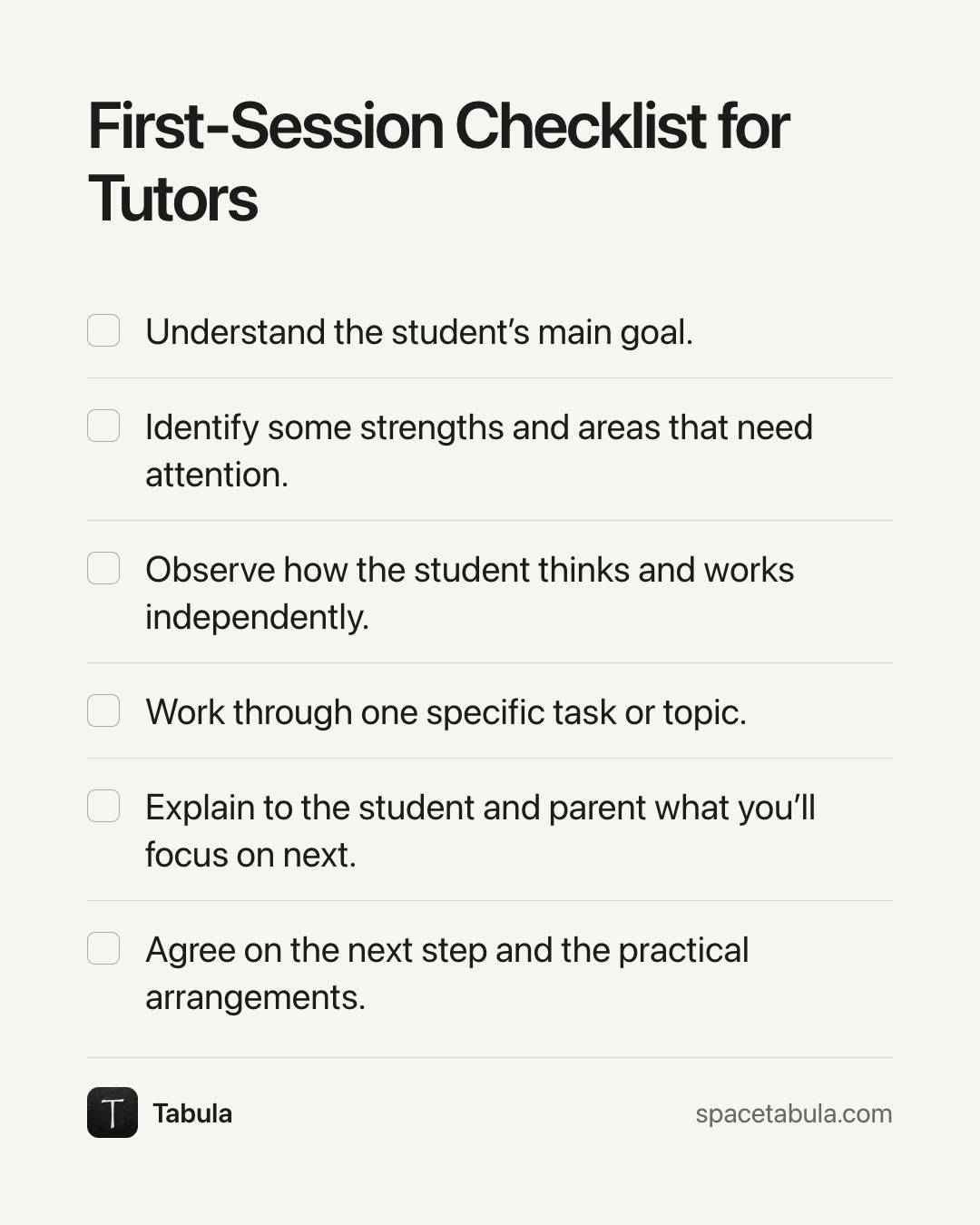
First-Session Checklist for Tutors
Before wrapping up, check whether you’ve managed to:
- Understand the student’s main goal.
- Identify some strengths and areas that need attention.
- Observe how the student thinks and works independently.
- Work through one specific task or topic.
- Explain to the student and parent what you’ll focus on next.
- Agree on the next step and the practical arrangements.
 Tabula
spacetabula.com
If you haven’t covered everything, don’t overload the lesson trying to catch up. You can gather the missing information later.
FAQs About the First Tutoring Session
Should the First Tutoring Session Be Free?
That’s up to you. You could offer a short introductory meeting, charge for a full lesson, or set a reduced rate for the first session. Whatever you choose, explain clearly what’s included so parents know what to expect.
What If the Student Is Shy and Doesn’t Want to Answer Questions?
Start with simple questions and accessible tasks. Give the student time to think, avoid rushing them, and don’t treat every mistake as a problem. It may help to let them write down their solution or explain it step by step. If a child seems very anxious, reduce the assessment workload and continue getting to know them in the next lesson.
Can You Fully Assess a Student’s Level in One Session?
Not always. A 60-minute lesson can usually give you an initial picture of the student’s level and reveal some learning gaps. A more thorough assessment may take several sessions, especially if there are significant gaps or the student is preparing for a demanding exam.
Should a Parent Sit In on the First Session?
It depends on the student’s age, independence, and the format of the lesson. A parent can help explain the goals, but it’s important to give the student a chance to speak for themselves. With teenagers and adult learners, it’s usually best to discuss goals directly with the learner.
What If You Realise You’re Not the Right Tutor for the Student?
Be honest with the parent or adult learner. If the student needs help outside your area of expertise or your teaching approach isn’t a good fit, explain this calmly. There’s no need to continue simply because you’ve already started working together.
How to Keep Track of What You Learned in the First Session
After the lesson, make a note of the student’s goals, strengths, difficulties, and the topic you plan to tackle next. These notes will help you prepare for the next session without having to start from scratch.
As your tutoring practice grows, it also helps to keep track of your schedule, lesson history, and payments for each student. Tabula helps tutors organise student and lesson information, track payments, outstanding balances and credits, record cancellations and rescheduled lessons, and review financial statistics.
Tabula
Schedule, students and payments in one place
Your first lesson doesn’t have to deliver instant results. Its purpose is to help you understand the student, choose a sensible direction for your work, and make the next steps clear to everyone involved.