How Tutors Can Keep Parents Updated on Student Progress: Tips and Message Examples
15 min read
Contents
- 1Why regular progress updates matter
- 2What should you include in a student progress update?
- 3How often should tutors update parents?
- 4How to write a student progress update: message examples
- 5How to discuss difficulties without blaming the student or the family
- 6What if parents are unhappy with the results?
- 7Why the student's perspective matters
- 8How to keep progress updates from becoming extra work
- 9A quick checklist before sending a progress update
- Frequently Asked Questions
- Final thoughts
Parents want to know whether tutoring is making a difference. But messages like “Everything is going well,” “Your child is doing great,” or “We’re making progress” rarely tell them what their child has actually learned.
Useful progress updates should be specific. They should highlight new skills, explain any ongoing difficulties, and give parents a clear idea of what comes next.
This doesn’t mean writing a detailed report after every lesson. A short, thoughtful update can be enough to show how a student is developing and what you are working towards. Here’s how to keep parents informed, what to include in your messages, and how to discuss situations when progress is slower than expected.
1. Why regular progress updates matter
Parents are not usually present during tutoring sessions, so they may not know what happens between one lesson and the next. Even when a child has been working with a tutor for several months, it can be difficult for a parent to see exactly what has changed.
Regular communication helps in several ways:
- It makes progress visible. Parents can see which skills their child has developed, what has become easier, and what they can now do independently.
- It puts difficulties into context. If a student is struggling with a particular topic, parents understand what is causing the difficulty and how you are addressing it.
- It keeps expectations realistic. Parents get a clearer picture of how long learning goals may take to achieve and what kind of practice is needed.
- It builds trust. Open communication helps parents understand your approach and share information that may affect the student's learning.
There is another important reason to communicate regularly: progress is not always reflected in test scores or grades.
A student may not have improved their marks yet, but they might now spot their own mistakes, explain their reasoning more clearly, or approach challenging tasks with greater confidence. These are meaningful signs of progress, too.
2. What should you include in a student progress update?
A useful update should be based on things you have actually observed, rather than general impressions. Instead of saying “Everything is fine,” explain what the student can do now and what still needs work.
Here are five areas worth covering.
1. Skills the student has developed
Mention the topics and skills the student can now use more confidently.
For example, a student might:
- solve simple equations independently;
- identify the main idea of a text;
- apply a spelling or grammar rule more accurately;
- understand the main points of a conversation in English;
- explain the steps they used to solve a problem.
Try not to simply list the topics you have covered. Focus on what the student can actually do as a result.
2. What has improved
Compare the student's current performance with what you observed at the beginning.
For example:
“When we first started working together, Alex often waited for hints before attempting a problem. Now Alex usually reads the question carefully, chooses an approach, and tries to solve it independently before asking for help.”
This kind of observation shows progress even if the student has not reached the final learning goal yet.
3. Difficulties that still need attention
Don't hide ongoing problems just to make your update sound positive. Parents need an honest picture of what their child is finding difficult.
The key is to be specific.
Instead of:
“Your child is struggling with maths.”
Try:
“Sam understands the individual steps in a word problem but still finds it difficult to decide which operation to use first. We’re working on identifying the key information and planning the solution before starting the calculations.”
The second message explains what is happening and what you are doing about it.
4. How the student approaches learning
Academic results are not the only useful measure of progress.
You can also observe whether the student:
- engages with the tasks;
- asks questions when something is unclear;
- attempts exercises independently;
- notices and corrects their own mistakes;
- applies familiar knowledge to new situations;
- needs fewer prompts than before.
These observations are particularly valuable when the goal is not simply to improve grades, but also to develop confidence and independent learning skills.
5. What comes next
Try to finish each update with a clear next step.
For example:
“In our next few sessions, we’ll continue working on word problems. First, we’ll practise identifying the information we need and what the question is asking. Then we’ll move on to planning solutions independently.”
This helps parents understand that your lessons follow a clear direction rather than being a series of unrelated activities.
3. How often should tutors update parents?
There is no single schedule that works for every student. The frequency of communication depends on the student's age, learning goals, lesson frequency, and the family's expectations.
Here are three practical options:
| Type of update | When it works well | What to include |
|---|---|---|
| A brief message after a lesson | When there is something important to share | Lesson topic, a notable achievement, homework, or next step |
| A short update every few lessons | For tracking ongoing progress | Skills developed, recurring difficulties, changes in independence |
| A more detailed monthly or termly review | For long-term tutoring with specific goals | Overall progress, examples of improvement, priorities for the next period |
You don't need to send a separate message after every lesson. If there is nothing significant to report, a quick note about the topic covered may be enough for your own records.
What matters most is agreeing on a communication routine in advance. For example, you might send brief messages when needed and provide a more detailed progress update once a month.
It is also worth agreeing on who your main point of contact will be: a parent or guardian, the student, or both. Discussing expectations and learning goals at the beginning can prevent misunderstandings later.
4. How to write a student progress update: message examples
You don't have to start from scratch every time. A simple structure can make writing updates much easier:
What we worked on → what went well → what still needs work → what comes next.
Here are some examples you can adapt to your subject and teaching situation.
Example 1. The student has made clear progress
“Hi! I wanted to share a quick update on Jamie’s progress. Over the last few weeks, Jamie has become much more confident working with fractions. They can now add and subtract fractions with the same denominator independently and are beginning to handle more challenging examples. We still need to practise working with different denominators, so that will be our focus in the next few lessons. It’s encouraging to see this progress!”
Example 2. Progress is gradual
“Hi! We’re continuing to work on spelling and grammar. Taylor is getting better at spotting words that need checking, but still finds it difficult to choose the correct spelling independently. We’re practising a step-by-step approach and gradually reducing the amount of help I give. For now, I’d like to focus on making this process more familiar and consistent before moving on.”
Example 3. The student is becoming more independent
“I’d like to highlight a positive change in Morgan’s work. They used to wait for my hints before attempting a problem, but now they make a real effort to understand the question and choose a strategy independently. They don't get everything right straight away, of course, but they're becoming much better at spotting and correcting their own mistakes. That's an important step towards working more confidently on their own.”
Example 4. Progress is slower than expected
“Hi! I’d like to talk about our recent lessons and how things are going. We haven't yet seen the progress we hoped for with solving equations. Even after reviewing the rules, Chris still finds it difficult to apply them independently. I think it may be worth adjusting our approach and revisiting a few foundational skills. I'd also like to check whether the current workload and homework feel manageable. Perhaps we can discuss this together and agree on the best way forward.”
These messages are examples, not scripts to copy word for word. The important thing is the approach: specific observations, a respectful tone, and a clear next step.
5. How to discuss difficulties without blaming the student or the family
Sometimes a progress update needs to address more than academic mistakes. A student may not complete homework, lose focus during lessons, miss sessions, or regularly arrive unprepared.
These situations can be sensitive, so it is important to describe what is happening without making personal judgements.
The basic rule is simple: focus on observable behaviour and its impact on learning, not on the student's character.
| Avoid saying | Try saying instead |
|---|---|
| “He is lazy and never does any work.” | “The homework hasn't been completed consistently over the last two weeks, which makes it harder to reinforce what we cover during lessons.” |
| “She is very careless.” | “During written tasks, Casey sometimes skips steps and doesn't always check their work before finishing.” |
| “Your child never remembers anything.” | “After a break, it can be difficult for your child to recall some of the rules independently, so I'll include a short review at the beginning of our next lessons.” |
| “You don't practise enough with your child at home.” | “Regular short practice between lessons would help reinforce these skills. Let's discuss what amount of practice would be realistic for your family.” |
Keep three principles in mind:
- Describe facts, not personalities. Refer to specific tasks, situations, and observations.
- Explore possible reasons instead of assigning blame. The difficulty might be related to the material, limited practice, a heavy workload, or a learning pace that needs adjusting.
- Suggest a way forward. Offer a practical next step that you and the family can discuss.
If the same issue keeps coming up, don't rely on brief messages indefinitely. Arrange a conversation with the parent and discuss the situation properly.
6. What if parents are unhappy with the results?
Even when you can see positive changes, parents may expect higher grades, faster improvement, or noticeable results after just a few weeks.
In this situation, avoid becoming defensive or promising to speed things up immediately.
Instead, take a step-by-step approach.
- Step 1. Listen to their concerns. Ask what results they expected and what is worrying them now. They may be focusing on school grades, while you are tracking the development of specific skills.
- Step 2. Revisit the original learning goals. Remind the family what you agreed to work on at the beginning. If their priorities have changed, discuss that too.
- Step 3. Show specific evidence of progress. Use examples of completed tasks, lesson notes, or short assessment results. Avoid relying on vague statements such as “Things are getting better.”
- Step 4. Agree on a realistic plan. Explain what might need to change: more practice, a different sequence of topics, a lighter workload, or additional time spent strengthening foundational skills.
If reaching the expected goal depends on extra lessons or independent practice, be honest about that.
Most importantly, don't guarantee a particular grade or promise that every learning gap will be fixed by a specific date unless you have a sound reason to make that commitment.
7. Why the student's perspective matters
When you work with children, remember that the parent may pay for the lessons, but the child is the one doing the learning. Communication should not become a conversation about the student that completely excludes them.
This is especially important when working with teenagers. If you need to discuss learning difficulties, a disagreement, or a change in behaviour with a parent, consider speaking to the student first whenever appropriate.
You can also ask students questions such as:
- What feels easier now than it did before?
- Which tasks do you still find challenging?
- Is there anything you would like to change about our lessons?
- Is there a topic you would like to spend more time on?
This helps students recognise their own progress and gradually take more responsibility for their learning.
Of course, serious concerns about a child's safety or wellbeing require a different approach. But in everyday tutoring, respecting the student's perspective and privacy helps build trust.
8. How to keep progress updates from becoming extra work
When you have several students, writing regular updates can quickly turn into another administrative task. The solution is not to write a detailed report after every lesson.
Try a simple system instead:
- After each lesson, record the topic and one or two important observations.
- Note what the student can do independently and where they still need support.
- Keep track of topics that need to be revisited.
- Use these notes to prepare a short update at the agreed time.
For example, your lesson note might look like this:
- Student: Anna
- Topic: Adding and subtracting fractions
- Doing well: Finds a common denominator with a little prompting
- Needs more practice: Simplifying fractions
- Next step: Practise simplifying and move on to word problems
It is much easier to turn a note like this into a useful message than to reconstruct the details of several lessons from memory.
If you work with multiple students, keeping a separate record of each student's lessons and notes can make a real difference. Tabula helps tutors manage their student list, keep a lesson history, add notes to students and individual lessons, and track lessons and other day-to-day administrative details. This keeps your teaching notes and your tutoring administration in one place.

Tabula
Schedule, students and payments in one place
9. A quick checklist before sending a progress update
Before sending a message to a parent, ask yourself:
- Have I explained what the student has actually learned or improved?
- Have I included at least one specific example?
- Have I mentioned ongoing difficulties, if there are any, without blaming anyone?
- Have I explained what we plan to work on next?
- Is the tone calm, clear, and respectful?
Tabula
spacetabula.com
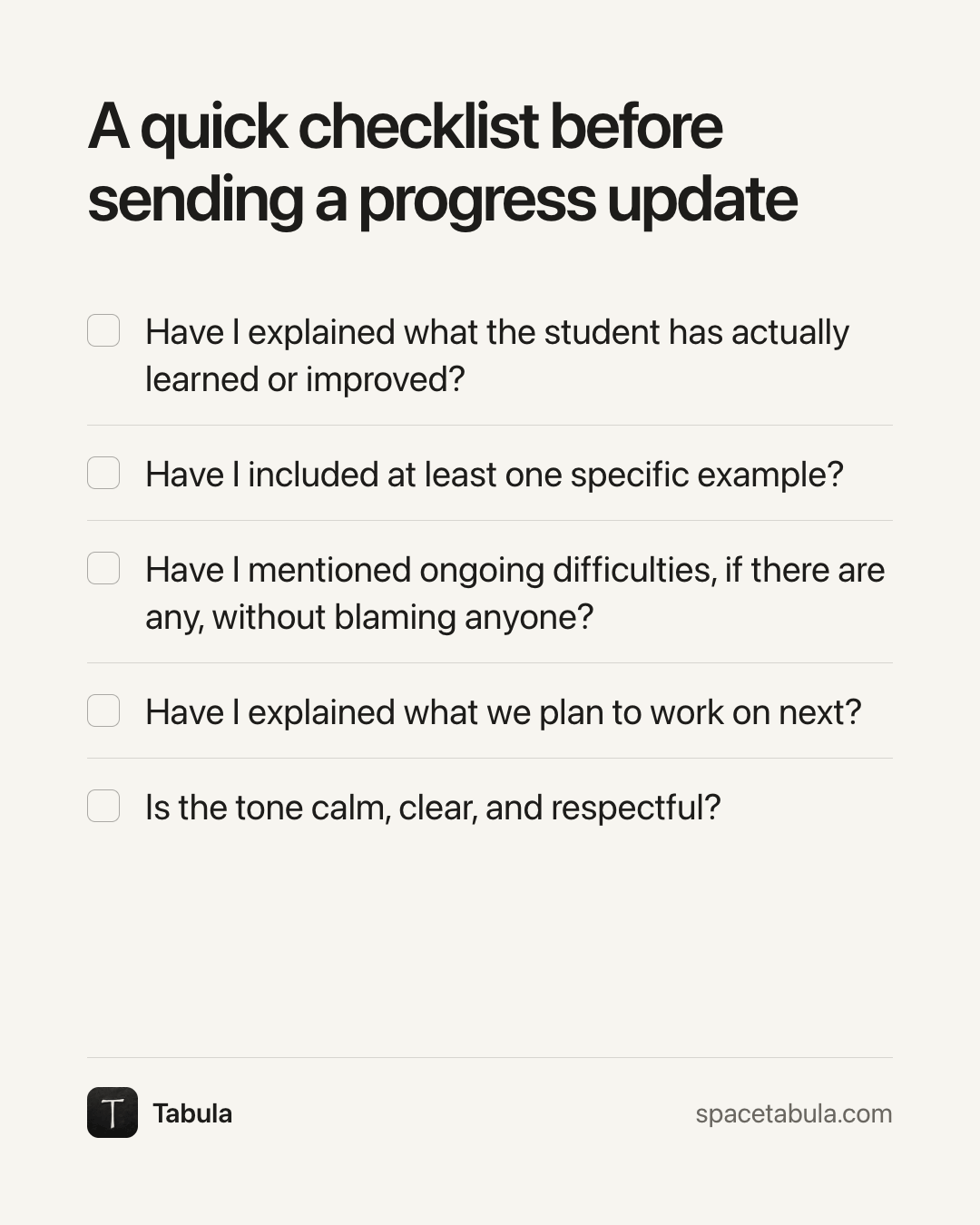
If you can answer yes to all five questions, your update is probably informative enough.
Frequently Asked Questions
Should tutors message parents after every lesson?
No. If you have agreed on a regular communication schedule, you can simply follow it. A separate message after a lesson is useful when something important happens: the student reaches a milestone, a new difficulty comes up, or you need to agree on the next step.
What if a parent asks for a detailed report after every lesson?
Discuss what information they actually need. You could offer a brief note after each session and a more detailed progress update every few weeks. The goal is to find a routine that works for the family without creating an unreasonable amount of extra work for you.
Should I tell parents about every mistake their child makes?
No. A progress update should not become a list of mistakes. Focus on recurring difficulties that affect learning and explain how you are helping the student work through them.
How should I explain that a student isn't making progress?
Be calm and specific. Explain which skill the student is still finding difficult, what you have already tried, and what you suggest changing. If you don't know the reason, avoid jumping to conclusions. Discuss the situation with both the student and the parent.
Should I share test results and grades with parents?
If they are relevant to the student's learning goals, yes. However, school grades should not be the only measure of progress. Consider the student's independence, the quality of their work, and their ability to apply what they have learned in new situations.
Final thoughts
A good progress update is more than a summary of completed lessons. It helps parents understand how their child is developing and where the learning process is heading.
You don't need to write a lot. What matters is being specific, honest, and consistent: recognise genuine achievements, explain ongoing difficulties, agree on the next steps, and remember to include the student's perspective.
When parents understand what happens during tutoring sessions and why you have chosen a particular approach, trust grows. And you can spend more of your time doing what matters most: helping your students learn.
Further reading
Sources and further guidance
- National Student Support Accelerator, Stanford University: Tutor/Program-Family Communication — Continual Updates — guidance on keeping families informed, agreeing on communication preferences, and maintaining student confidentiality.
- Education Endowment Foundation: Teacher Feedback to Improve Pupil Learning — evidence-informed guidance on making feedback specific, useful, and focused on moving learning forward.