How Much Do Tutors Earn? Hourly Rates, Monthly Income and Realistic Examples
8 min read
Contents
- How Much Do Tutors Charge per Hour?
- How Much Can You Earn from Tutoring?
- How Much Should You Charge per Hour?
- How Much Can Online Tutors Earn?
- What Expenses Affect a Tutor’s Income?
- Why Does Tutoring Income Change from Month to Month?
- How Can You Earn More Without Teaching More Hours?
- How to Calculate Your Potential Monthly Income
- So, Is Tutoring a Good Way to Earn Money?
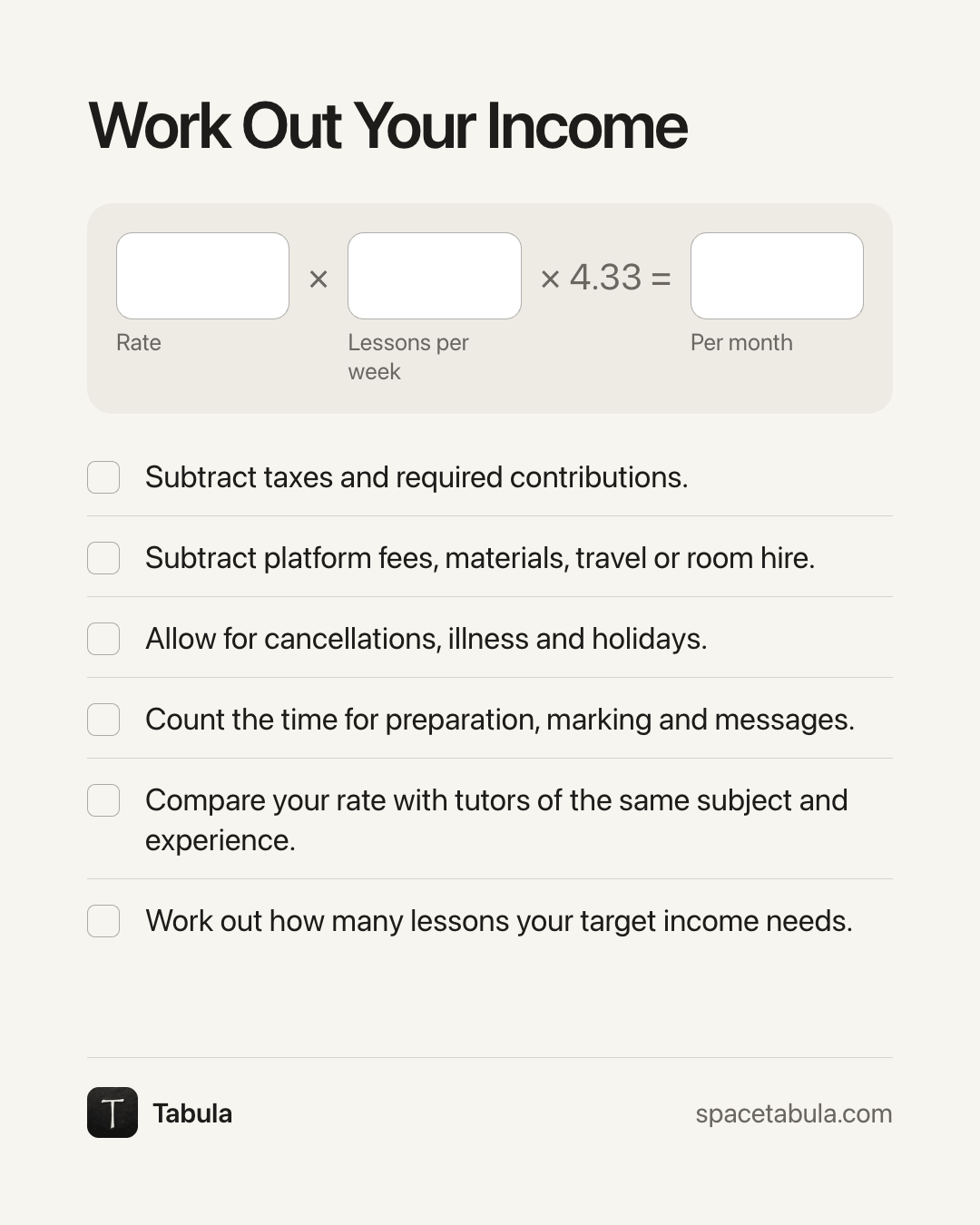
- Work Out Your Income
Tutoring can be a flexible side hustle or a full-time career. But how much can you actually earn?
Your income depends on more than the number of students you teach. Your hourly rate, weekly workload, cancellations and the time you spend preparing lessons all affect how much you make.
Here’s how to estimate your potential earnings, set your rates and build a tutoring business that works for you.
How Much Do Tutors Charge per Hour?
Tutoring rates vary widely depending on the subject, student level, tutor’s experience and location.
For example, Tutorful, a UK tutoring platform, reports an average tutoring price of around £37.45 per hour. These figures reflect activity on one platform, not a guaranteed rate or an official average for every tutor in the UK. Read Tutorful’s pricing guide.
In the US, Wyzant reports typical tutoring prices of around $35–$60 per hour on its platform, with rates varying by subject and tutor expertise. Explore Wyzant’s tutoring cost guide.
These examples illustrate how much rates can differ between markets. Before setting your own price, research tutors who teach the same subject, level and type of student in your target market.
How Much Can You Earn from Tutoring?
Your monthly income depends on the combination of your hourly rate and the number of lessons you teach. A tutor with a small number of high-paying clients may earn as much as someone with a much busier schedule.
Here are a few illustrative scenarios using UK pounds. They are calculations, not predictions of what tutors typically earn.
| Tutoring setup | Lessons per week | Rate per lesson | Monthly revenue |
|---|---|---|---|
| A few students, premium rate | 6 | £65 | £1,689 |
| Many lessons, lower rate | 20 | £18 | £1,559 |
| Moderate workload and rate | 12 | £30 | £1,559 |
| Part-time tutoring | 4 | £25 | £433 |
| Busy schedule, higher rate | 18 | £40 | £3,118 |
The estimates assume each lesson lasts one hour, every scheduled lesson takes place and payment is collected. Monthly revenue is calculated using an average of 4.33 weeks per month. These amounts are before taxes, business expenses and unpaid time.
The table shows why the number of students alone doesn’t tell the whole story. Six lessons at £65 each generate more revenue than twenty lessons at £18 each, despite requiring much less teaching time.
However, charging a higher rate usually requires a clear reason for students to choose you, such as specialist knowledge, strong experience, exam preparation expertise or a proven track record.
How Much Should You Charge per Hour?
There is no single rate that works for every tutor. Your price should reflect the value of your teaching while remaining competitive in your target market.
Consider these factors when setting your rate:
- Subject and specialisation. Advanced mathematics, specialist language instruction and exam preparation may command higher rates than general academic support.
- Experience and qualifications. Relevant credentials, teaching experience and positive reviews can help justify a higher fee.
- Student goals. Helping a student prepare for a major exam may require more planning and specialised knowledge than supporting them with weekly homework.
- Location and audience. Local rates and customers’ budgets can differ significantly. Online tutoring may let you reach students beyond your immediate area.
- Lesson format. In-person sessions may involve travel or room hire, while online lessons can reduce some operating costs.
To find a sensible starting point, compare several tutors with similar qualifications, subjects and target students. Look at the prices they advertise, what their services include and how they position themselves.
You don’t necessarily need to be the cheapest option. A clear offer, relevant expertise and well-organised lessons can be more valuable than a low hourly rate.
How Much Can Online Tutors Earn?
Online tutoring removes the need to travel between lessons and makes it possible to work with students in different cities or countries. It can also make scheduling easier.
For example, imagine you teach four one-hour lessons a day, five days a week, at £30 per lesson.
4 lessons × 5 days × £30 × 4.33 weeks = £2,598 per month.
That is your projected monthly revenue if every lesson goes ahead and is paid for. It does not include taxes, expenses or cancellations.
Remember that teaching hours are only part of the job. You may also need to prepare materials, mark assignments, respond to messages and plan each student’s progress. Twenty lessons a week can therefore involve considerably more than twenty hours of work.
Online tutors can find students independently, use tutoring marketplaces or work for an online education company. Each option has different advantages. Independent tutors have more control over their rates, while platforms and employers may offer access to students but operate under their own payment terms and fees.
What Expenses Affect a Tutor’s Income?
Revenue is not the same as take-home income. Before estimating your earnings, consider the costs of running your tutoring business.
These may include:
- Taxes and required contributions.
- Platform or payment processing fees.
- Teaching materials and subscriptions.
- Computer equipment, internet access and software.
- Travel or room rental for in-person lessons.
- Time spent on lesson preparation, administration and finding new students.
The exact costs and tax obligations depend on where you live and how you work. Check the rules that apply to your location rather than relying on a percentage or tax estimate intended for another country.
Why Does Tutoring Income Change from Month to Month?
Even if your hourly rate stays the same, your income may fluctuate throughout the year.
Students may take holidays, become ill, pause lessons after an exam or stop tutoring when they reach a particular goal. New students may also take time to find.
To make your income more predictable, agree on clear cancellation and payment policies, encourage consistent lesson schedules and keep track of upcoming breaks. Building a steady base of regular students can help reduce the impact of occasional cancellations.
It’s also worth leaving room in your schedule for preparation and rest. Filling every available hour may increase short-term revenue but can become difficult to sustain.
How Can You Earn More Without Teaching More Hours?
Increasing your income doesn’t always mean adding more students to your schedule.
- Review your rates regularly. As your experience grows or your specialisation becomes more valuable, check whether your current price still reflects your work.
- Develop a clear specialisation. A focused offer, such as exam preparation or support for a specific age group, helps potential students understand what makes your lessons relevant to them.
- Build long-term student relationships. Clear goals, useful feedback and visible progress can encourage students to continue lessons over time.
- Reduce administrative work. Keeping lesson records, schedules, student details and payments organised makes it easier to manage your workload. Tools such as Tabula can help tutors handle these tasks in one place instead of relying on scattered notes and messages.
- Protect your time. Consider how much preparation each lesson requires and whether your schedule leaves enough time for other responsibilities. A higher rate for specialised work may be more sustainable than a much larger number of lower-priced lessons.

Tabula
Schedule, students and payments in one place
How to Calculate Your Potential Monthly Income
Use this simple formula:
Monthly revenue = hourly rate × lessons per week × 4.33
For example, if you teach 12 lessons per week at £30 per hour:
£30 × 12 × 4.33 = £1,558.80 per month.
This is revenue before taxes and expenses. To make the estimate more realistic, account for cancellations, school holidays, unpaid lessons and time spent on work outside the classroom.
Start with your target monthly income and work backwards. How many lessons would you need at your current rate? Could you realistically fill those slots? How much additional time would you need for preparation and administration?
This approach gives you a more useful picture than simply multiplying your ideal hourly rate by a full working week.
So, Is Tutoring a Good Way to Earn Money?
Tutoring can provide a useful side income or become a full-time business. The amount you earn depends on your rates, workload, demand for your subject and how effectively you manage your time.
You don’t have to teach as many hours as possible to earn a worthwhile income. A smaller number of well-paid lessons may suit you better than a packed schedule at a lower rate.
The best starting point is to calculate your potential revenue, account for expenses and unpaid work, and decide what workload is realistic for you. That way, you can build a tutoring business around both your financial goals and the time you want to keep for yourself.
Work Out Your Income
A short summary of this article: save it and fill in your own numbers.
- Subtract taxes and required contributions.
- Subtract platform fees, materials, travel or room hire.
- Allow for cancellations, illness and holidays.
- Count the time for preparation, marking and messages.
- Compare your rate with tutors of the same subject and experience.
- Work out how many lessons your target income needs.
Tabula
spacetabula.com